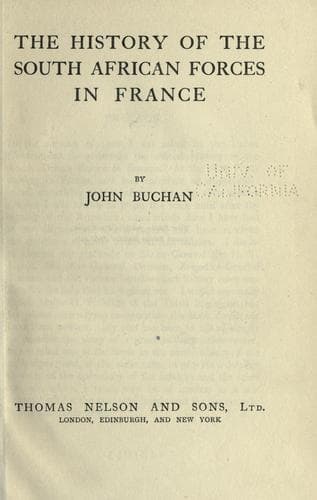
The history of the South African forces in FranceBuchan, John
History
The history of the South African forces in France
Buchan, John
South Africa. Army; World War, 1914-1918 -- Campaigns -- France; World War, 1914-1918 -- Regimental histories -- South Africa
This sight cheered the thin ranks of the defence, and about noon came
news which exalted every heart. General Tudor sent word that the 35th
Division, which had arrived at Bray-sur-Somme, under Major-General
Franks, had been ordered to take up position 1,000 yards in rear of the
Brigade. For a moment it seemed as if they still might make good their
stand. But the 35th Division was a vain dream. It was never during that
day within miles of the South Africans. Dawson sent back a report on the
situation to General Tudor.
It was the last communication of the Brigade with the outer world.
At midday the frontal attack had been held, an attack on the south had
been beaten off, and so had a very dangerous movement in the north. The
grass in that parched week was as dry as tinder. The enemy set fire to
it and, moving behind the smoke as a screen, managed to work his way to
within 200 yards of our position in the north. There, however, he was
again checked. But by this time the German thrust elsewhere on the front
was bearing fruit. Already the enemy was in Combles on the north and at
Péronne and Cléry on the south. The 21st Division had gone, and the other
brigades of the 9th Division were being forced back on the South African
left. At about half-past two on that flank an officer with some thirty
men began to withdraw under the impression that a general retirement had
been ordered. As they passed Headquarters, Major Cochran and Captain
Beverley, with Regimental Serjeant-Major Keith of the 4th Regiment, went
out to stop them under a concentrated machine-gun fire. The party at once
returned to the firing-line and were put into shell-holes on the north
flank. Unhappily Cochran was hit in the neck by a machine-gun bullet and
died within three minutes.
Dawson, early in the afternoon, attempted to adjust his remnant. The
enemy now was about 200 yards from his front and far in on his flank
and rear. Major Ormiston took out some twenty-five men as a flank-guard
for the left, in which performance he was dangerously wounded. All
wounded who could possibly hold a rifle were stopped on their way to
the dressing-station, and sent back to the front line, and in no single
instance did they show any reluctance to return. Ammunition was conserved
with a noble parsimony, and the last round was collected from casualties.
But it was now clear that the enemy was well to the west of the Brigade,
for snipers’ fire began to come from that direction. Unless the miracle
of miracles happened the limit of endurance must be reckoned not in
hours but in minutes. For the moment the most dangerous quarter seemed
to be the north, and Lieutenant Cooper of the 2nd Regiment, with twenty
men, was sent out to make a flank-guard in shell-holes 100 yards from
Brigade Headquarters. The little detachment did excellent work, but their
casualties were heavy, and frequent reinforcements had to be sent out to
them. Lieutenant Cooper himself was killed by a fragment of shell.
Public-domain text, read in full here on John Shaqi.
Reviews
Reviews
No reviews yet
Be the first to share your thoughts on this work.
Elsewhere in the archive
Join the Discussion
Join the discussion
Sign in to leave a comment or review.
Sign InorCreate an account