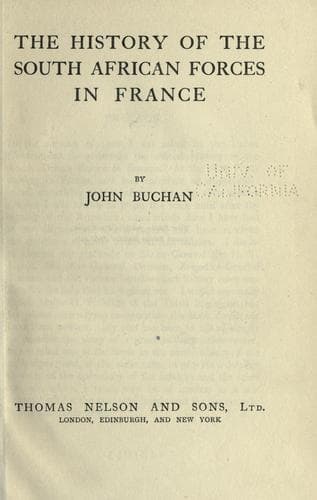
The history of the South African forces in FranceBuchan, John
History
The history of the South African forces in France
Buchan, John
South Africa. Army; World War, 1914-1918 -- Campaigns -- France; World War, 1914-1918 -- Regimental histories -- South Africa
The Brigade had ceased to be. It had surrendered—such a surrender as
Sir Richard Grenville made, when the _Revenge_ fought for a day and a
night against the fleets of Spain. Less than 100 unwounded prisoners
fell to the enemy; the rest were killed or crippled or lost, all but the
little group of details and stragglers now in the transport lines. Heal
and Cochran were dead, MacLeod was wounded, Dawson and Christian were
prisoners. The rest of the 9th Division, along with the remnants of the
21st, were now fighting desperately north of the Somme behind Cléry,
struggling to the line from Hem through Trônes Wood to Longueval, where
the 35th Division and the 1st Cavalry Division were to come to their aid.
It will be remembered that two companies of the South Africans had gone
astray on the night of the 22nd and had since been fighting with other
brigades. There were also the parties left behind in the Brown Line on
that date, which had been unable to rejoin their units, and there were
the posts which Dawson had flung out on his right flank on the 23rd, and
which had lost their road in the last withdrawal. These oddments, along
with the details and the transport of the Brigade, collected that evening
half-way between Bray and Maricourt, and on the following day were formed
into a composite battalion of three companies under Lieutenant-Colonel
Young. Each company represented a regiment of the Brigade, No. 1 being
under Captain Burgess, No. 2 under Lieutenant Jenner, and No. 3 under
Lieutenant G. Smith. The fighting strength was some 450 rifles. On the
26th they were ordered to Dernancourt to report to General Kennedy of
the 26th Brigade. They there found the 9th Division holding a line from
that village to south of Albert, and took up a position in trenches and
along the railway embankment south-east of the former place. This ground
they held in spite of furious enemy efforts to dislodge them, until they
were relieved by the Australians on the night of the 27th, when the whole
division was withdrawn from the line.
* * * * *
In all that amazing retreat, when our gossamer front refused to be
broken by the most fantastic odds, no British division did more nobly
than the 9th. It held a crucial position in the line, and only by its
stubborn endurance was a breach between Gough and Byng prevented. Among
the brigades of the 9th, the chief brunt was borne by the South African.
A great achievement is best praised in the language of the commanders
themselves. General Tudor wrote:—
Public-domain text, read in full here on John Shaqi.
Reviews
Reviews
No reviews yet
Be the first to share your thoughts on this work.
Elsewhere in the archive
Join the Discussion
Join the discussion
Sign in to leave a comment or review.
Sign InorCreate an account