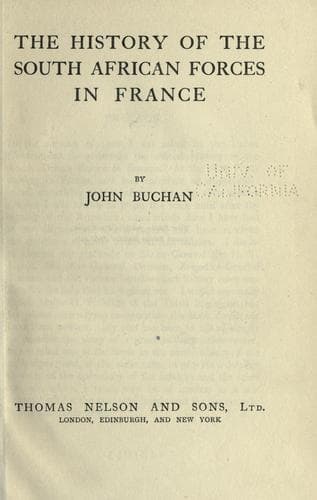
The history of the South African forces in FranceBuchan, John
History
The history of the South African forces in France
Buchan, John
South Africa. Army; World War, 1914-1918 -- Campaigns -- France; World War, 1914-1918 -- Regimental histories -- South Africa
The Interlude—The Strategic Situation during the Summer—The
Méteren Area—Awaiting the German Attack—The Action of 25th
June—The Capture of Méteren on 19th July—The End of the
Composite Battalion—The Brigade re-formed—Leaves the 9th
Division and joins the 66th.
The summer of 1918 may be regarded as an interlude in the history of the
South African forces in France. The continuity was not broken, for there
was still a titular South African Brigade, commanded by a South African
general; but the old regiments had shrunk to companies, and only one
battalion was South African in its composition. Again, the summer months
were for the northern part of the British line a time of comparative
quiet. The great tides of war had flowed southward, and before May was
out came Ludendorff’s thrust on the Aisne, which drove the French back
upon the Marne and in seventy-two hours advanced the enemy front by more
than thirty miles. In that southern area the German tactics of April
were repeated, and presently von Hutier pressed forward on the right,
and carried the Lassigny hills. Then, after a delay of six weeks, came
the last attack on the Marne, which was to open the way to Paris, and
with it Ludendorff’s final and irretrievable failure. But in the early
summer that consummation could not have been foreseen, and the months of
May, June, and July were an anxious season for the Allied Command. When
Foch became Commander-in-Chief his first problem was to create reserves,
and his second to use just enough of them to hold the enemy. While the
American armies were growing in numbers and efficiency he had to be
ready, with still scanty resources, to face at any moment a new assault
on any one of four sections of his long line. But his defence was not
stagnant; it was as vigilant and aggressive as any attack; and there were
two facts in the situation which might well seem to him of happy augury.
He had devised an answer to the new German tactics, and formed his own
scheme against the day of _revanche_. Again, the German strategy was
clearly fumbling. The Lys had seen the decadence of the original plan,
and the later adventures were blind and irrelevant hammer-blows. Germany,
with waning strength, was being forced to stake all on a last throw; if
that failed, she might soon be helpless before the waxing might of the
Allies.
* * * * *
Public-domain text, read in full here on John Shaqi.
Reviews
Reviews
No reviews yet
Be the first to share your thoughts on this work.
Elsewhere in the archive
Join the Discussion
Join the discussion
Sign in to leave a comment or review.
Sign InorCreate an account