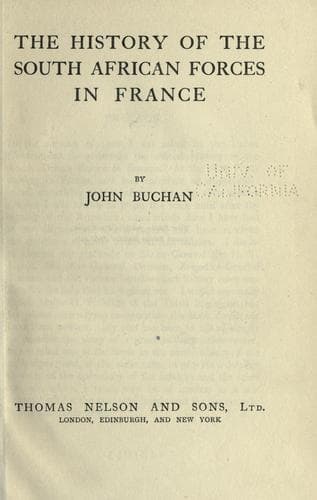
The history of the South African forces in FranceBuchan, John
History
The history of the South African forces in France
Buchan, John
South Africa. Army; World War, 1914-1918 -- Campaigns -- France; World War, 1914-1918 -- Regimental histories -- South Africa
The Brigade during the summer was with the 9th Division in the area of
Plumer’s Second Army. That front in the north was in no secure position,
for the advance of the enemy in April had brought him too near to certain
vital centres like Béthune and Hazebrouck, and he held the key-point of
Kemmel. It was well within the domain of possibility that the next great
stroke might fall in the north, and the British Army, which had been
actively engaged for nine weeks, was very tired. Hence there could be no
sleeping anywhere on the line between Ypres and Arras. Till the end of
May an attack was hourly expected.
[Sidenote: _May 25._]
From the 10th to the 23rd May the Brigade was busy training in the
Heuringhem area. On the latter date, with the 5th Cameron Highlanders
in place of the 9th Scottish Rifles, it marched to Hondeghem, and next
day relieved the 26th Brigade in the support line, the South African
Battalion, on the left, being available as a counter-attack battalion.
On the 25th, since a German attack seemed to be imminent, it was decided
to hold the 9th Division sector with a two-brigade front: on the left
the 26th Brigade, with two battalions in line and one in support; on
the right the South African Brigade, with one battalion in line, one in
support, and the South African Composite Battalion in divisional reserve
in the village of Thieushoek. The 27th Brigade was at Hondeghem in corps
reserve.
The enemy was believed to be aiming at Mont des Cats, the western end
of the Kemmel range, the possession of which would directly threaten
Hazebrouck and the whole northern plain. At that time our front ran
in this area from Locre by the north of Bailleul and just west of the
village of Méteren to a point half-way between Strazeele and Merris.
The sector taken over by the Brigade lay facing Méteren from the
Méteren-Cassel road to the tiny watercourse called Méteren Becque, which
ran south-east from Flêtre. The defences were organized in two zones.
The front line consisted of sections of trenches covered by an outpost
line between 150 and 200 yards in front of them, in close touch with the
enemy; a support line, with the strong-point of Princboom in it; and a
reserve line based on Flêtre. This forward zone was almost completely
overlooked by the enemy in Méteren, and any movement by day there was
impossible. The second zone, some 2,000 yards in the rear, included the
fortified village of Caestre.
During these days patrols were busy on the quest for prisoners, and from
the intelligence thus gathered it appeared that the German attack was
fixed for the morning of the 29th. Much work was done in strengthening
the defences, and a special battalion was formed of Brigade details,
which was held at Caestre in divisional reserve. But nothing happened on
the 29th. That night the South African battalion moved into the support
line, and on the 1st June it relieved the 2nd Royal Scots Fusiliers in
the front line.
[Sidenote: _June 2._]
Public-domain text, read in full here on John Shaqi.
Reviews
Reviews
No reviews yet
Be the first to share your thoughts on this work.
Elsewhere in the archive
Join the Discussion
Join the discussion
Sign in to leave a comment or review.
Sign InorCreate an account