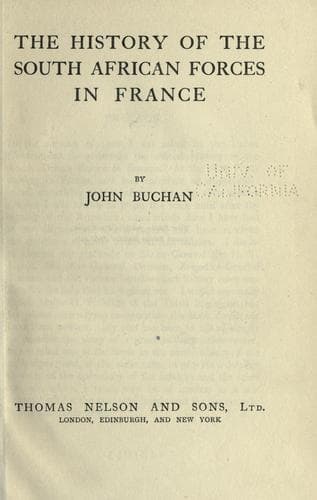
The history of the South African forces in FranceBuchan, John
History
The history of the South African forces in France
Buchan, John
South Africa. Army; World War, 1914-1918 -- Campaigns -- France; World War, 1914-1918 -- Regimental histories -- South Africa
“I wish to express to you and to your officers, warrant
officers, N.C.O.’s, and men of the Brigade under your command
my great regret that the exigencies of the service prevented
me seeing you all personally before you were transferred from
the 9th Division, in order to say good-bye. For two and a half
years your Brigade has shared the fortunes of the 9th Division.
At Delville Wood, at Arras, at Ypres, in the Somme retreat, and
finally at Méteren, it has fully contributed in establishing
and maintaining the glorious record of this division. The South
African Brigade bore the brunt of the attack on the divisional
front on March 21, 1918, and its final stand at Bouchavesnes on
24th March, when it held out all day until all ammunition was
exhausted, will live as one of the bravest feats of arms in the
War. The cheery keenness and comradeship with which the South
African Brigade has always worked and fought will be very much
missed by me personally, and by all the 9th Division. We wish
you and your Brigade the best of fortune, and know that you
will always fully maintain the splendid name you have earned.”
The division with which they were now brigaded had come later into
the campaign than the 9th, but it had no mean record behind it. Under
Major-General Neill Malcolm it had done gloriously in the retreat from
St. Quentin, when it had been reduced to a handful. It was re-formed in
the late summer under the command of Major-General H. K. Bethell, and,
besides the South Africans, included the 198th and 199th Brigades, the
units of which had been brought from Salonika. In the 198th Brigade were
the 6th Lancashire Fusiliers, the 5th Royal Inniskilling Fusiliers,
and the 6th Royal Dublin Fusiliers. In the 199th were the 18th King’s
Liverpool Regiment, the 9th Manchesters, and the 5th Connaught Rangers.
The pioneer battalion was the 9th Gloucesters. The War brought the
soldiers of South Africa into comradeship with all varieties of the New
Armies of Britain. Hitherto they had fought side by side with the Scots;
the last stage was to be spent in a fighting fellowship, not less close
and cordial, with the men of Ireland and the North of England.
CHAPTER XI.
THE ADVANCE TO VICTORY.
(September 28-November 11, 1918.)
Foch’s Final Strategy—Progress of the Campaign in August and
September—The End of the Siegfried Zone—The 66th Division
in Action—The Fight of 8th October—The South Africans take
their Objectives—The Fight of 9th October—The Brigade
Captures Bertry, Maurois, and Reumont—The Line of the Selle
reached—The Enemy Position at Le Cateau—Preparation for
the Attack—Lieutenant Hewat’s Exploit—The Battle of 17th
October—South African Captures and Casualties—Splendour of the
Achievement—The Last Stage in the Campaign—Tanner’s Mobile
Column—The Last Shots at Grandrieu—The Armistice.
Public-domain text, read in full here on John Shaqi.
Reviews
Reviews
No reviews yet
Be the first to share your thoughts on this work.
Elsewhere in the archive
Join the Discussion
Join the discussion
Sign in to leave a comment or review.
Sign InorCreate an account