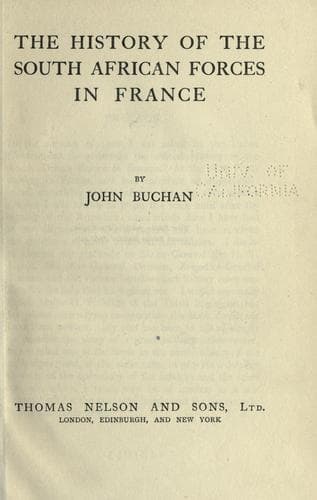
The history of the South African forces in FranceBuchan, John
History
The history of the South African forces in France
Buchan, John
South Africa. Army; World War, 1914-1918 -- Campaigns -- France; World War, 1914-1918 -- Regimental histories -- South Africa
On the day before the capture of Méteren, Foch on the Marne had delivered
the great counterstroke which decided the issue of the campaign. When on
that morning the troops of Mangin breasted the Montagne de Paris they
had, without knowing it, won the second Battle of the Marne, and with
it the War. The final battle had been joined, and the greatest modern
soldier had entered upon the first stages of that mighty contest, which
in two months’ time was to shatter all Germany’s defences, and enable him
to begin that deadly _arpeggio_ on the whole front from the Moselle to
the North Sea which brought her to her knees. It was fitting that South
Africa should be represented by more than a battalion in the final march
to victory. During August 1,000 reserves arrived at Lumbres from England,
and it was now possible to consider the reorganization of the Brigade.
On the 28th the Composite Battalion marched to Lumbres and prepared
for disbandment. Since its formation on 24th April it had been almost
continually in the line. Seventy-five officers had served with it at one
time or another, and of these 7 had been killed and 11 wounded. Of the
men, 84 had been killed, 27 had died of wounds, 329 had been wounded, and
one was missing. For the operations in which it had taken part it had won
two bars to the Military Cross, three Military Crosses, one Distinguished
Conduct Medal, one bar to the Military Medal, and thirty Military Medals.
The four months had been an interlude in the main story of the South
Africans in France, but an interlude not without its own glory.
On 11th September the Brigade, now re-formed, was withdrawn from the 9th
Division, with which the South Africans had served since their arrival
in France. For the purpose of administration it was transferred to the
VII. Corps, with which it trained till 22nd September. On that day it
joined the 66th Division, which was then attached to the First Army. It
was commanded, as before, by General Tanner, and in addition to the three
infantry battalions contained the Signal Section, the South African Light
Trench Mortar Battery, and the 1st South African Field Ambulance. The
1st Regiment was under the command of Major H. H. Jenkins, the 2nd under
Lieutenant-Colonel H. W. M. Bamford, and the 4th under Lieutenant-Colonel
D. M. MacLeod.
It was not easy for the South Africans to leave the 9th Division, or
for the 9th Division to part with them. Together they had fought in
the bitterest actions of the campaign, and their glory was eternally
intertwined. I quote General Tudor’s farewell letter to Tanner.
Public-domain text, read in full here on John Shaqi.
Reviews
Reviews
No reviews yet
Be the first to share your thoughts on this work.
Elsewhere in the archive
Join the Discussion
Join the discussion
Sign in to leave a comment or review.
Sign InorCreate an account