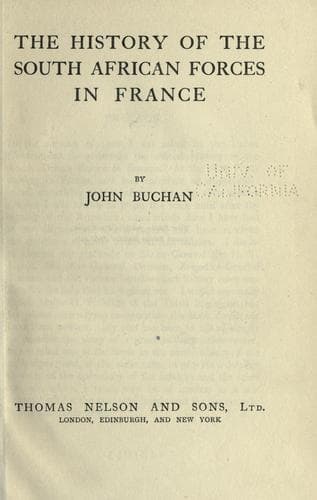
The history of the South African forces in FranceBuchan, John
History
The history of the South African forces in France
Buchan, John
South Africa. Army; World War, 1914-1918 -- Campaigns -- France; World War, 1914-1918 -- Regimental histories -- South Africa
On 6th October the 66th Division was warned that it would be used
presently in a major operation in which the Fourth and Third Armies would
co-operate. The object was to destroy the remnants of the Beaurevoir
line, and with it the Siegfried zone. The country was the last slopes
of the Picardy uplands, where they break down to the flats of the
Scheldt—wide undulations enclosing broad, shallow valleys. There was
little cover save the orchards and plantations around the farms and
hamlets, but there were many sunken roads, and these, combined with the
perfect field afforded everywhere for machine-gun fire, made it a good
land for rearguard fighting. The XIII. Corps was now the right flank
of the Fourth Army, with the II. United States Corps on its right, and
the British V. Corps on its left. The 66th Division was in the centre
of the corps, and the task specially committed to it was the capture of
Serain. General Bethell attacked with two brigades—the South African on
the right and the 198th on the left, each on a two-battalion front. The
starting-point was a line running north-west and south-east through the
eastern outskirts of Beaurevoir village. In the South African Brigade
the 2nd Regiment was on the right and the 4th on the left, with the 1st
Regiment in support.
[Illustration: LIEUTENANT-COLONEL D. M. MACLEOD, D.S.O., M.C., D.C.M.,
Commanding 4th Regiment, South African Infantry.]
[Sidenote: _Oct. 8._]
It was a wild, wet autumn morning when Byng and Rawlinson advanced on a
seventeen-mile front, from south of Cambrai to Sequehart, while Débeney
extended the battle four miles farther south. Zero hour for the Fourth
Army was 5.10; for the Third Army, 4.30. The South African Brigade had
moved on the 7th into the Siegfried lines at Bony, and by 3.30 a.m. on
the 8th it had occupied its battle position. Unfortunately the assembly
was not completed without loss. A preliminary attack by the 38th and 50th
Divisions on Villers and Villers-Outréaux brought down a retaliatory
barrage from the enemy, and among the wounded was Lieutenant-Colonel
Bamford, the commanding officer of the 2nd Regiment. His place was taken
by Major Sprenger.
Public-domain text, read in full here on John Shaqi.
Reviews
Reviews
No reviews yet
Be the first to share your thoughts on this work.
Elsewhere in the archive
Join the Discussion
Join the discussion
Sign in to leave a comment or review.
Sign InorCreate an account