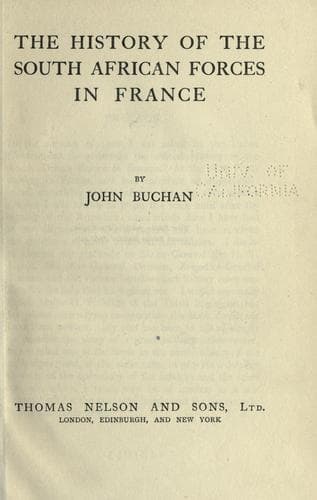
The history of the South African forces in FranceBuchan, John
History
The history of the South African forces in France
Buchan, John
South Africa. Army; World War, 1914-1918 -- Campaigns -- France; World War, 1914-1918 -- Regimental histories -- South Africa
He had not reckoned with Foch—nor with Haig, for on the 26th there
began on the Meuse the _arpeggio_ of attack which broke through the
defences prepared during four years, and in six weeks brought Germany
to surrender. On the 27th Haig struck at the main Siegfried zone from
Cambrai to St. Quentin, and his blow was meant to shatter. It is no
secret that the opinion of his Allies and of his own Government was not
favourable to his boldness: even Foch, while he agreed that the plan was
the right one, doubted its feasibility. The British Commander-in-Chief
took upon himself the responsibility of one of the most audacious
operations of the War, and, daring greatly, greatly succeeded. That day
Byng and Horne with the Third and First British Armies crossed the Canal
du Nord, and next day reached the Scheldt Canal. On the 28th, too, the
Belgians and Plumer’s Second Army swept east from Ypres, and Mangin and
Guillaumat opened a new battle between the Ailette and the Vesle. On
the 29th came the main blow at the Siegfried citadel, when Rawlinson’s
Fourth Army, in conjunction with Byng and Débeney, crossed the Scheldt
Canal, and stormed their way far into the fortified zone. In days of wind
and cloud they enlarged this gap till St. Quentin fell, and Cambrai was
utterly outflanked. On 30th October the Australians broke through the
northern part of the Beaurevoir-Fonsommes line, the last of the Siegfried
works, and looked into open country. Between the 27th September and the
7th October Haig had crossed the two great canals, and destroyed all but
the final line of the Siegfried zone, while this final line in one part
had been passed. The time had come for an advance on a broad front which
should obliterate the remnants of the Siegfried works, and with them
Germany’s last hope of a safe winter position. Her nearest refuge would
be the Meuse, and, shepherded by Foch’s unrelenting hand, it was very
certain that her armies would never reach the banks of that fateful river.
[Sidenote: _Sept. 28._]
On 28th September the 66th Division had been transferred to Rawlinson’s
Fourth Army, and by the 5th October it had moved south to the old Somme
area, and was in the neighbourhood of Ronssoy. It was now part of Sir T.
L. Morland’s XIII. Corps, which contained also the 18th, 25th, and 50th
Divisions. Of these, the 25th was composed of troops brought from the
Italian front, and the 50th, like the 66th, of battalions from Salonika
and Palestine. Two of the divisions of the corps were, therefore, made up
largely of men who had malaria in their bones, and there was some doubt
as to how they would stand an autumn campaign in Picardy—a doubt which
was soon to be put at rest. The 18th and 25th Divisions and the South
African Brigade were well seasoned to northern warfare.
[Sidenote: _Oct. 6._]
Public-domain text, read in full here on John Shaqi.
Reviews
Reviews
No reviews yet
Be the first to share your thoughts on this work.
Elsewhere in the archive
Join the Discussion
Join the discussion
Sign in to leave a comment or review.
Sign InorCreate an account