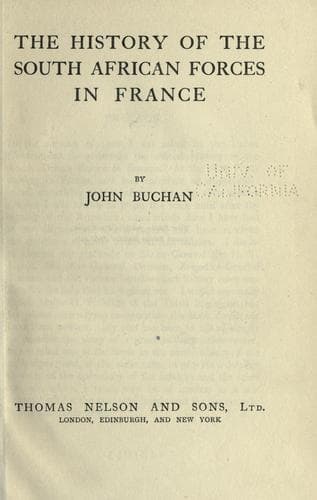
The history of the South African forces in FranceBuchan, John
History
The history of the South African forces in France
Buchan, John
South Africa. Army; World War, 1914-1918 -- Campaigns -- France; World War, 1914-1918 -- Regimental histories -- South Africa
It was now the eve of the last great fight of the Brigade—the last,
indeed, of the campaign in the West. To understand it we must note the
configuration of the battle-ground. The valley of the Selle at Le Cateau
has on each side slopes rising to plateau country some 200 feet above
the bed of the river. On the west these slopes mount gently in bare
undulations, but to the east they rise more abruptly, and the country
in that direction is intersected with many orchards and hedges. A spur
running north-east from Montay to Forest gives direct observation up
the valley and over the eastern uplands. The Selle at Le Cateau is from
fifteen to twenty feet wide, and usually about four feet deep, but with
the recent heavy rains it was now rising fast. South of the town it flows
through marshy meadows; in the town itself the banks are bricked up,
and it is spanned by two bridges; farther north towards Montay it runs
through firm pasture land. Le Cateau is a town normally of some 10,000
inhabitants, full of solidly built houses and factories, the greater part
of which are on the slopes east of the river. On its eastern side runs
the railway to Solesmes, which with its embankments and cuttings gave
the enemy a position of exceptional strength. A formidable strong-point
was the railway station and yard, which were bounded on the east by a
bank thirty feet high, while a mound farther east, which could not be
seen from the west bank of the Selle, gave good observation southwards.
The position from the point of view of the defence was all but perfect.
The wiring was everywhere elaborate, the machine-gun posts had been
prepared on a lavish scale, and the buildings and cellars were admirably
adapted for a prolonged resistance. Four enemy divisions held the
place, and two of them were fresh from reserve. The importance which
the German High Command laid upon a stand on the Selle—which they knew
as the “Hermann Line”—was shown by orders captured during our attack.
One, issued by General von Larisch commanding the 54th Corps, announced
that the Army would accept a decisive battle on that line, which must
be held at all costs. An order of an artillery group declared that the
possibility of an armistice being arranged depended on the battle coming
to a standstill on the Selle. Still another artillery order warned the
troops that if the Hermann Line were held, a favourable peace could be
arranged; otherwise there was no prospect of an end to the War. If the
position was vital to the enemy, it was no less vital to the Allies. By
10th September the two main German salients—between the Lys and the Somme
and between the Selle and the Argonne—had become precarious. Ludendorff
had now but the one object, to protect the main lateral railway, from
Lille by Valenciennes and Hirson to Mézières, long enough to permit of
an orderly retreat. If it fell too soon, large parts of his front would
be cut off. It was Haig’s aim to cut that railway as soon as possible by
Public-domain text, read in full here on John Shaqi.
Reviews
Reviews
No reviews yet
Be the first to share your thoughts on this work.
Elsewhere in the archive
Join the Discussion
Join the discussion
Sign in to leave a comment or review.
Sign InorCreate an account