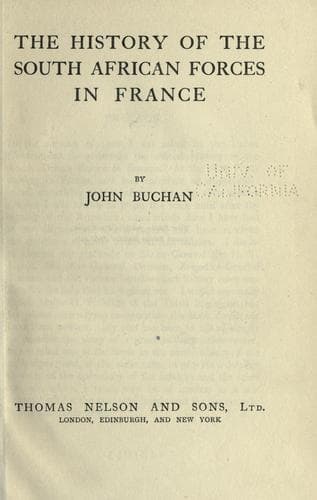
The history of the South African forces in FranceBuchan, John
History
The history of the South African forces in France
Buchan, John
South Africa. Army; World War, 1914-1918 -- Campaigns -- France; World War, 1914-1918 -- Regimental histories -- South Africa
forcing the Selle and pressing on to Maubeuge across the many rivulets
which drain to the Scheldt from the Forest of Mormal.
[Sidenote: _Oct. 11._]
On 11th October the position was that the XIII. Corps held ground in the
skirts of Le Cateau west of the Selle and along the river line. A frontal
attack was impossible, and the town must be enveloped by its flanks. On
the south the floods were extending, and a crossing place must be sought
well upstream, so the Corps extended its right wing to St. Souplet.
Simultaneously with any advance in the south there must be a movement
on the north to capture the ridge north-east of the town. The immediate
objective was the Solesmes-Le Cateau railway and the easterly ridge; the
ultimate goal the village of Bazuel.
[Sidenote: _Oct. 12-15._]
Several days had to be spent in preliminary work. On the night of the
11th the South African Brigade moved up from Reumont and relieved the
198th and 199th Brigades. The 1st Regiment held the line opposite Le
Cateau with the 2nd and 4th Regiments in support on right and left.
Between the 12th and the 15th the 1st pushed forward north of the town
to the edge of the Selle. It was no easy task, for the western outskirts
were not yet cleared of the enemy, and our positions were dominated by
the high ground on the eastern bank and by the houses in the northern
suburbs. In these days the 1st Regiment suffered some twenty casualties
in officers and men, while a post of one N.C.O. and seven men was
reported as missing. The next task was to establish bridgeheads in the
area of the town itself, and in particular to hold the two ruined
bridges. The capture of one of these was assigned to the 2nd Regiment,
and Major Sprenger on the 15th ordered Second-Lieutenant R. D. Hewat,
with one Lewis gun section and one rifle section, to establish posts
east of the bridge on both sides of the road. Owing to the constant
machine-gun fire the débris of the bridge could not be used, so
Lieutenant Hewat and his men waded across the stream, heavily bombed all
the while by the enemy, and carried out their instructions. During the
16th he was frequently attacked, but with seven survivors he held his
ground, and when the general advance began next morning he was found
engaged against three machine guns. Late that day he rejoined the Brigade
after a most gallant feat of arms, having held out for over thirty-six
hours.
Public-domain text, read in full here on John Shaqi.
Reviews
Reviews
No reviews yet
Be the first to share your thoughts on this work.
Elsewhere in the archive
Join the Discussion
Join the discussion
Sign in to leave a comment or review.
Sign InorCreate an account