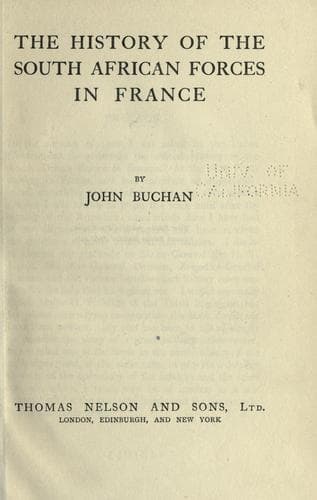
The history of the South African forces in FranceBuchan, John
History
The history of the South African forces in France
Buchan, John
South Africa. Army; World War, 1914-1918 -- Campaigns -- France; World War, 1914-1918 -- Regimental histories -- South Africa
The flanks of the advance were exposed; and since the bulk of the 5th
Cavalry Brigade had not come up, General Bethell moved forward the 199th
Brigade on the right of the South Africans in the direction of Sivry,
where they were in touch with the 20th Hussars. The instructions of the
advanced guard were to keep close to the enemy, but not to attack if he
was found in a strong position. Accordingly Tanner did not force the
advance, and in the afternoon the 1st Regiment was ordered to dig in.
It was thought likely that the Germans might retreat during the night,
so vigilant patrolling was carried out; but at dawn on the 11th the
situation had not altered. In the meantime the bridge at Hestrud had been
rebuilt by the Engineers.
[Sidenote: _Nov. 11._]
The morning of Monday, 11th November, was cold and foggy, such weather as
a year before had been seen at Cambrai. Very early, while the Canadians
of Horne’s First Army were entering Mons, the 1st Regiment attacked,
but could make little progress, though a patrol under Second-Lieutenant
Cawood managed to gain some ground on the left flank. By 8 o’clock a
considerable advance was made on the right, where the 20th Hussars were
feeling their way through Sivry. At 10 a.m. Tanner received by telephone
the news that an armistice had been signed. “Hostilities,” so ran the
divisional order, “will cease at 11 o’clock to-day, 11th November.
Troops will stand fast on the line reached at that hour, which will be
immediately reported by wire to Headquarters, Fourth Army Advance Guard.
Defensive precautions will be maintained. There will be no intercourse of
any description with the enemy until receipt of instructions.” The news
must have reached the enemy lines earlier, and he signalized its arrival
by increasing his bombardment, as if he had resolved to have no surplus
ammunition left when the hour of truce arrived.
Punctually at 11 o’clock the firing on both sides ceased. There came a
moment of dramatic silence, and then a sound as of a light wind blowing
down the lines—the echo of men cheering on the long battle front. The
meaning of victory could not in that hour be realized by the weary
troops; they only knew that fighting had stopped, and that they could
leave their trenches without disaster. The final “gesture” fell to the
arm which from the beginning of the campaign had been the most efficient
in the enemy service. At two minutes to eleven a machine gun opened about
two hundred yards from our leading troops at Grandrieu, and fired off
a whole belt without a pause. A German machine gunner was then seen to
stand up beside his weapon, take off his helmet, bow, and, turning about,
walk slowly to the rear.
Public-domain text, read in full here on John Shaqi.
Reviews
Reviews
No reviews yet
Be the first to share your thoughts on this work.
Elsewhere in the archive
Join the Discussion
Join the discussion
Sign in to leave a comment or review.
Sign InorCreate an account