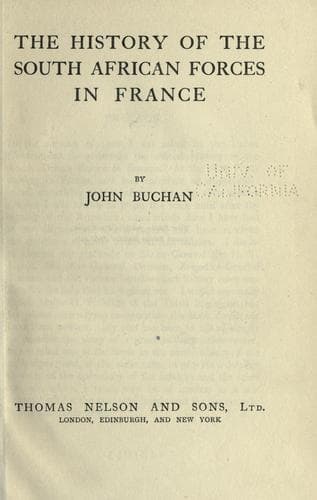
The history of the South African forces in FranceBuchan, John
History
The history of the South African forces in France
Buchan, John
South Africa. Army; World War, 1914-1918 -- Campaigns -- France; World War, 1914-1918 -- Regimental histories -- South Africa
We have already seen (Chapter I.) that the five batteries of the old
South African Heavy Artillery Brigade were armed, on arriving in England,
with 6-inch howitzers and affiliated to the Royal Garrison Artillery,
becoming the 73rd, 74th, 71st, 72nd, and 75th Siege Batteries, R.G.A.
In April 1916 a sixth battery, the 125th, was formed. Early in 1918 a
seventh battery, the 542nd, and an eighth, the 496th, were created, but
when they arrived in France they were broken up, and their guns and
_personnel_ distributed, the first between the 75th and the 125th,
and the second between the 72nd and 74th. A ninth battery, the 552nd,
armed with 8-inch guns, was formed in the autumn of 1918, but the War
ended before it could be brought into action. We have therefore to
deal with six siege batteries, which were engaged in France from the
summer of 1916 to the date of the armistice. At first the batteries were
independent units, being allotted to widely separated corps and heavy
artillery groups. It was not till the beginning of 1918 that they were
brought together, and two South African Brigades formed, the 44th and the
50th—the 44th including the 73rd (S.A.), 71st (S.A.), 125th (S.A.), and
20th Batteries; and the 50th, the 74th (S.A.), 72nd (S.A.), 75th (S.A.),
and 275th. It will be convenient to take the doings of each battery
separately up to January 1918, and thereafter to deal with the record of
the two brigades.
THE 73RD SIEGE BATTERY, R.G.A.
This Battery, after its period of training in England, landed at Havre
on May 1, 1916, under the command of Major Walter Brydon. On 9th May it
reached Bienvillers-au-Bois, in the Somme area, where it took up a battle
position under the command of the 19th Artillery Group. On 15th May it
fired its first round for sighting purposes. On 1st July, when the First
Battle of the Somme began, it covered the infantry advance on Gommecourt,
attaining the record of thirty-two rounds in eight minutes with each gun.
On 17th July it moved to the village of Berles-au-Bois, and was engaged
in smashing enemy trenches and counter-battery work in the neighbourhood
of Monchy-au-Bois and Ransart. On 25th August it moved back to Doullens,
and thence to Albert, where it took up position in the ruins of La
Boisselle. Here it supported the attack on Pozières, Courcelette, and
Thiepval; and Major Brydon was wounded while observing for the Battery
in the front trenches. In October it advanced its position to Pozières,
where it suffered considerably from enemy fire, and had its fill of
discomforts from the weather of that appalling winter. In February 1917
Major Brydon returned to duty; and on the 15th of that month two officers
of the Battery, Lieutenant Campion and Second-Lieutenant J. Currie,
advancing with the infantry to the capture of Boom ravine, rallied two
companies whose officers had all been killed, and captured two strong
machine-gun posts. Lieutenant Campion fell in this gallant exploit, and
Public-domain text, read in full here on John Shaqi.
Reviews
Reviews
No reviews yet
Be the first to share your thoughts on this work.
Elsewhere in the archive
Join the Discussion
Join the discussion
Sign in to leave a comment or review.
Sign InorCreate an account