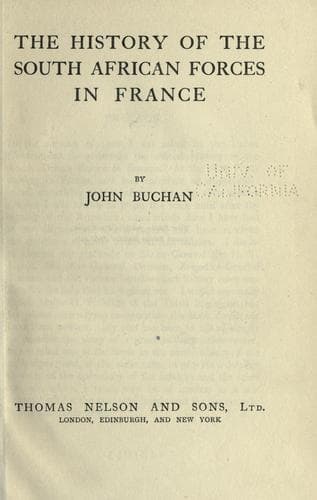
The history of the South African forces in FranceBuchan, John
History
The history of the South African forces in France
Buchan, John
South Africa. Army; World War, 1914-1918 -- Campaigns -- France; World War, 1914-1918 -- Regimental histories -- South Africa
The Battery was now attached to the Belgian Army as one of the thirteen
siege batteries constituting the XIV. Corps Heavy Artillery. Its position
was in the swampy country in the neighbourhood of Steenvoorde and
Oostkerke. On 3rd December it moved to the La Bassée area, and rejoined
the First Army, taking up position at Annequin. On January 9, 1918, there
came a short space of rest near Lillers. Major Begbie handed over the
command to Major J. G. Stewart, and the Battery became part of the 44th
(S.A.) Brigade.
THE 44TH (SOUTH AFRICAN) HEAVY ARTILLERY BRIGADE.
On January 29, 1918, Lieutenant-Colonel T. H. Blew, D.S.O., of the South
African Defence Force, took command of the Brigade, with headquarters
at Beuvry Château. The four batteries were in position east and south
of Béthune. During February and March this was a quiet sector, but the
batteries were busy preparing reserve positions in depth in view of
a possible German attack. From the first day of April the guns were
actively engaged in counter-battery work.
The German assault came on 9th April, and one of its main objectives
was the right pillar of the British front at Givenchy, held by the 55th
Division. All the battery positions of the Brigade, except that of the
125th, had been located by the enemy, who from the early morning drenched
them with high explosives and gas shells. For a time all communications
with Brigade Headquarters were cut. The falling back of the division on
their left allowed the enemy to advance almost up to their gun positions.
The 73rd Battery was in the most hazardous case, and owing to the
shelling it was impossible to bring up motor transport to evacuate its
guns. Major Brydon, who had returned the month before from hospital to
the command of the Battery, was ordered to blow up his guns, but instead
he served out rifles and a couple of machine guns to his men, and bade
them stand to. At one time he had to send the breech-blocks to the rear
for safety, but the attack was stayed before it reached the guns, and the
breech-blocks were brought back. Though wounded and gassed, he refused to
leave his Battery. Finally he was compelled to retire. The men dragged
the guns for nearly a mile under cover of darkness, and by 2 a.m. on
the morning of the 10th a new position had been found, and the Battery
was again in action. The casualties of the Brigade that day were 13 men
killed, and 6 officers and 29 men wounded.
Public-domain text, read in full here on John Shaqi.
Reviews
Reviews
No reviews yet
Be the first to share your thoughts on this work.
Elsewhere in the archive
Join the Discussion
Join the discussion
Sign in to leave a comment or review.
Sign InorCreate an account