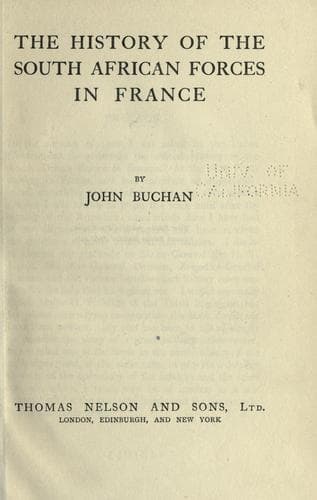
The history of the South African forces in FranceBuchan, John
History
The history of the South African forces in France
Buchan, John
South Africa. Army; World War, 1914-1918 -- Campaigns -- France; World War, 1914-1918 -- Regimental histories -- South Africa
The stand on the 9th checked the enemy for a time, and all batteries
were able to take up less exposed positions. They suffered, however,
from a continuous bombardment, and on the 12th the heroic commander of
the 73rd was killed by a shell. He had left the doctor’s hands when a
severe burst of German fire began, and had hurried forward to see to his
guns. No officer in the British Army had a finer record for gallantry
and devotion to duty. His Battery was known everywhere on the front as
“Brydon’s Battery,” and he was beloved by his men, for his only thought
was for them. During the 9th, though wounded himself, he helped to dress
the other wounded, and when the men at the guns began to show signs of
exhaustion, he himself dealt out rum to them. Finally he went through a
downpour of shells to find a doctor and more dressings. It was one of the
many ironies of the war that he never received the Victoria Cross, for
he won it a dozen times. Let his epitaph be the words of a gunner in his
Battery, who had served with him only a few weeks, and who on the 9th had
his arms and legs shot away. Major Brydon stopped and asked if he could
do anything for him. The dying man raised himself on his stumps. “By God,
Brydon,” he cried, “you are a man. I’m only good for the parson now, but
I’m proud to die under you.”
The 18th of April saw another severe bombardment, when five officers
of the 73rd Battery were gassed—Captain P. A. M. Hands, the second in
command, and Second-Lieutenants Maasdorp and Brown dying of the effects.
This meant a loss to the Brigade, since the 9th, of five officers dead.
The expenditure of ammunition during that period had been enormous: the
71st Battery, for example, fired 11,000 rounds. The Brigade remained on
the same front till the 27th June, when it was brought out to rest. On
the 27th July Lieutenant-Colonel Blew relinquished his command, being
succeeded temporarily by Major E. H. Tamplin, who, on 17th August,
handed over to Lieutenant-Colonel G. M. Bennett, formerly commanding the
74th Battery.
Public-domain text, read in full here on John Shaqi.
Reviews
Reviews
No reviews yet
Be the first to share your thoughts on this work.
Elsewhere in the archive
Join the Discussion
Join the discussion
Sign in to leave a comment or review.
Sign InorCreate an account