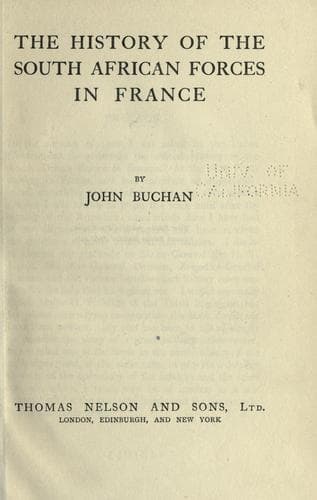
The history of the South African forces in FranceBuchan, John
History
The history of the South African forces in France
Buchan, John
South Africa. Army; World War, 1914-1918 -- Campaigns -- France; World War, 1914-1918 -- Regimental histories -- South Africa
On the 12th the batteries advanced, first to Tortequesne, and then to
Estrées and Noyelle. On the 19th they were at Lewarde. On the 20th a
section of the 74th Battery moved to Wallers to support the Canadian
attack. This was the last engagement of the Brigade in the War, for on
the 24th it was placed in army reserve, and remained there till the
armistice on 11th November.
APPENDIX II.
THE SOUTH AFRICAN SIGNAL COMPANY (R.E.)
INCEPTION AND ORGANIZATION—AUGUST-OCTOBER 1915.
At the beginning of the war the service of communications in the Imperial
Army was organized as the Signals Branch of the Corps of Royal Engineers.
This provided and maintained all communications, comprising Telegraphs,
Telephones, Visual Signalling, and Despatch Riders (Horse, Motor-Cycle,
and Cycle). A Signal Service Company, suitably equipped and organized for
its multifarious duties, was provided in war establishments as a part
of the headquarters of each of the higher formations—Division, Corps,
and Army. The development of scientific trench warfare on the Western
Front vastly increased both the importance and the complexity of the
communications of the contending armies; and when, towards the close of
the campaign in German South-West Africa, the composition of the Union
Oversea Contingent was decided, the offer of a Divisional Signal Company
was willingly accepted by the Imperial authorities.
The raising of this Company was entrusted to Major N. Harrison,
Engineer-in-Chief of the Union Post Office, who had acted as Director
of Signals to the Union Forces during the Rebellion and the German
South-West African Campaign. For the acceptance of his recruits Major
Harrison set such a high standard of specialized knowledge, character,
intelligence, and military experience, that the assembling of the two
hundred and thirty men of the original Company occupied the whole of
August and September 1915. Eventually a magnificent body of picked
men were assembled in Potchefstroom Camp fully representative of all
South Africa, from the Zambesi to Cape Town. In view of the technical
nature of the new unit’s duties, it was natural that a high proportion
of the recruits should come from the Transvaal, and particularly the
Witwatersrand. The relative figures were—
Recruited in Transvaal 53.7 per cent.
(Of these, 64 per cent. from Johannesburg.)
Cape 25 ”
Natal 12.7 ”
Orange Free State 6.6 ”
Rhodesia, etc. 2 ”
Public-domain text, read in full here on John Shaqi.
Reviews
Reviews
No reviews yet
Be the first to share your thoughts on this work.
Elsewhere in the archive
Join the Discussion
Join the discussion
Sign in to leave a comment or review.
Sign InorCreate an account