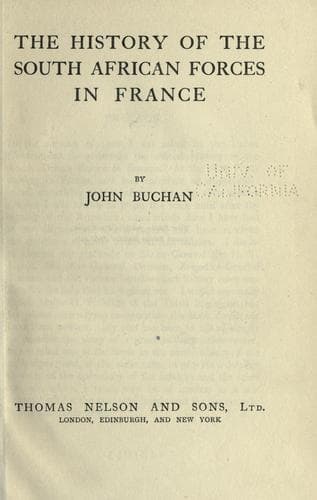
The history of the South African forces in FranceBuchan, John
History
The history of the South African forces in France
Buchan, John
South Africa. Army; World War, 1914-1918 -- Campaigns -- France; World War, 1914-1918 -- Regimental histories -- South Africa
The standard of physique was very high, and fully correspondent to the
maturity shown by an average age of 28.4 years. The backbone of the
Company consisted of skilled telegraphists and linemen from the Union
Post Office, the majority of whom had served in German South-West Africa,
and in previous wars. The drivers, whose excellent horsemanship impressed
every one at the training centre in England, were recruited mainly from
the farming population, and included many young Dutchmen.
By the beginning of October all the officers, who had been selected from
officials of the engineering branch of the post office and electrical
engineers of the Witwatersrand, had joined, and on the 17th October the
unit, in company with the S.A.M.C. and details of the South African
Brigade and S.A.H.A., sailed for England on the _Kenilworth Castle_, with
a strength of six officers—Major N. Harrison commanding—Lieutenants J.
A. Dingwall, R. H. Covernton, J. Jack, F. H. Michell, F. M. Ross—and 229
other ranks. The Company arrived at Bordon Camp, Hants, on 4th November.
REORGANIZATION AND TRAINING OF THE COMPANY IN ENGLAND—NOVEMBER 1915-APRIL
1916.
Owing to the demands of the German East African Campaign, in which the
Union Government was now engaged, there was no prospect of infantry units
for the Western Front beyond the one brigade already in England. As the
South African Brigade would, therefore, constitute only one-third of the
infantry of some Imperial division, the Company could not serve with the
Infantry Brigade in the capacity of a divisional signal company, as
originally contemplated. On the other hand, new army corps were in course
of formation, and corps signal companies had to be raised and trained
for them. A corps signal company requires a high proportion of skilled
technicians in the ranks, and as, owing to the commanding officer’s care
in selecting his recruits, the company possessed such a proportion, the
War Office decided that it should be reorganized in order to form a Corps
Signal Company, and proceed to the Signal Service Training Centre in
Bedford for the necessary specialized training. The Company accordingly
entrained for Hitchin on the 23rd November, and during the next few days
was reorganized.
Public-domain text, read in full here on John Shaqi.
Reviews
Reviews
No reviews yet
Be the first to share your thoughts on this work.
Elsewhere in the archive
Join the Discussion
Join the discussion
Sign in to leave a comment or review.
Sign InorCreate an account