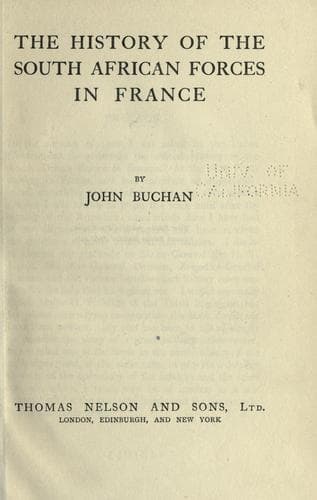
The history of the South African forces in FranceBuchan, John
History
The history of the South African forces in France
Buchan, John
South Africa. Army; World War, 1914-1918 -- Campaigns -- France; World War, 1914-1918 -- Regimental histories -- South Africa
After a day at Havre the move was continued—motor transport sections
by road and cable sections by train—to Vignacourt. At this village in
the Somme Valley, between Abbeville and Amiens, the headquarters of the
newly constituted XV. Corps was concentrating under Lieutenant-General
Horne, and Major Harrison, on the 23rd April, was appointed Assistant
Director of Army Signals—_i.e._ Staff Officer for Signals to the Corps
Commander. The Company now became the XV. Corps Signal Company, and
served continuously with that Corps throughout the remainder of the war.
A few days later the Corps moved into line between the III. and XIII.
Corps, becoming a part of the Fourth Army under General Sir H. Rawlinson,
and took over the sector fronting Fricourt and Mametz, between Bécourt
and Carnoy. On the 30th April the Company took over from the XIII. Corps
Signal Company at Heilly, a village on the Ancre, near Corbie. B.F. and
B.G. sections were sent to join the headquarters of the two divisions
in line—the 7th and 21st respectively—and B.F. section proceeded to
Ville-sur-Ancre, where Brigadier-General Napier, commanding the Corps
Heavy Artillery, had his headquarters, and took charge of the Heavy
Artillery’s communications on the 27th April.
The experience of previous battles had shown that, next to an adequate
artillery, the primary technical condition for a successful offensive
was good and reliable communication between the assaulting infantry,
the directing staffs, and the supporting artillery. Overground wires,
no matter how multiplied, failed immediately under the counter-barrage.
Visual signalling, slow at the best, was generally ineffective because
of the smoke and dust of the barrage, the exposure of the _personnel_,
and the unsuitability of the terrain, so faith was now pinned on cables
laid in deep trenches for thousands of yards in rear of the front line,
carrier pigeons, and runners. As soon as the area could be thoroughly
surveyed, a programme of work was drawn up covering:—
(_a_) Reconstruction of and additions to the inadequate open
wire routes in the back area, from Corps headquarters up
to behind Méaulte, Morlancourt, and the Bois des Tailles,
sufficient to cope with the number of units and formations
to be thrown in for the battle, and suitably designed and
located for rapid extension along the probable roads of
the anticipated advance.
(_b_) A complete network of cable trenches extending from the
heads of the open wire routes to the front line, providing
telephone communication down to company and battery command
posts and artillery observation posts.
Public-domain text, read in full here on John Shaqi.
Reviews
Reviews
No reviews yet
Be the first to share your thoughts on this work.
Elsewhere in the archive
Join the Discussion
Join the discussion
Sign in to leave a comment or review.
Sign InorCreate an account