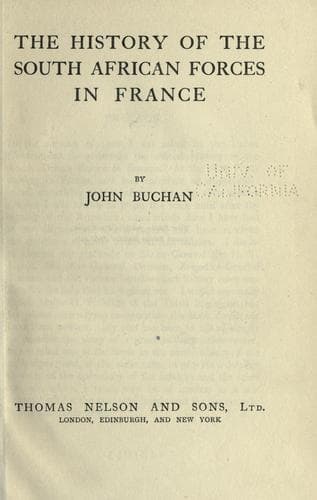
The history of the South African forces in FranceBuchan, John
History
The history of the South African forces in France
Buchan, John
South Africa. Army; World War, 1914-1918 -- Campaigns -- France; World War, 1914-1918 -- Regimental histories -- South Africa
In the early part of 1916 the deficiencies of technical equipment, in
the supply of materials and of labour, were still great. The Signal
Sections were then equipped for mobile warfare only, and found themselves
carrying out heavy semi-permanent work with scarcely any of the usual
tools and appliances. The work of the Ministry of Munitions had not yet
produced its full fruits in supply, and though the Deputy-Director of
Army Signals—Colonel R. G. Earle—did everything possible to meet the
Company’s requirements, signal material—particularly cable—was scanty,
and deliveries of a hand-to-mouth order. The Labour Corps was then a
thing of the future, and, therefore, the whole of the massive works
required for the offensive—roads, railways, dumps, dug-outs, etc.—had
to be performed by the infantry in their turns out of the line. In such
circumstances there was never enough labour to go round, and it required
all the commanding officer’s tact and persuasiveness to secure the
minimum of digging labour required for the cable trenches; all other
unskilled work had to be thrown on the skilled sappers of the Company,
and to free the outdoor men for construction, the telegraphists, after a
long day at their instruments, had often to spend half the night loading
and off-loading in the forward area masses of cable, poles, and line
material.
Labour for the Heavy Artillery cable trenches was not secured till June,
when two battalions from each division were placed under the direction
of Lieutenant Ross for this work. Digging the trenches and laying cable
were then pressed forward continuously night and day. Much of the work
was only possible at night, as the ground was under direct observation,
and the few skilled sappers available, after working most of the night
with infantry digging parties, had to be turned out again at dawn, day
after day, to take charge of scratch cable-laying parties made up from
the signallers of batteries. The Heavy Artillery allotment for the XV.
Corps in the coming battle was twenty-three batteries, organized in five
groups, and an independent railway battery. The tactical conditions
made the communication problem one of peculiar difficulty, because they
enforced the siting of the batteries in two main clusters—one in the
valley of the Ancre and the other in Happy Valley—both on the extreme
flanks of the Corps’ frontage. Further, owing to the enemy’s tenure of
the Fricourt salient, many batteries, to carry out their work, had to
establish communication with observation posts sited on the opposite
flank of the Corps area to the position of the batteries, and the most
favourable O.P. positions lay far outside the Corps boundaries. The fact
that many of the batteries only took position and settled on their O.P.’s
in the last few days was an additional complication.
Public-domain text, read in full here on John Shaqi.
Reviews
Reviews
No reviews yet
Be the first to share your thoughts on this work.
Elsewhere in the archive
Join the Discussion
Join the discussion
Sign in to leave a comment or review.
Sign InorCreate an account