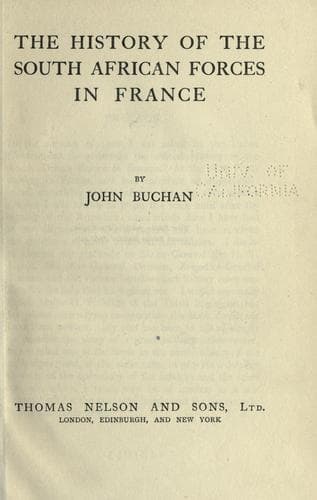
The history of the South African forces in FranceBuchan, John
History
The history of the South African forces in France
Buchan, John
South Africa. Army; World War, 1914-1918 -- Campaigns -- France; World War, 1914-1918 -- Regimental histories -- South Africa
This situation did not bring any relaxation to the Signal Company. The
German artillery, whose work behind the front line had been feeble
immediately after the 1st July, had now been heavily reinforced, and the
salient position of the Corps inevitably drew much enfilade fire. One
of the effects was the continuous destruction of lines back to points
thousands of yards from the front. In moving up after the 14th July,
all units had finally passed beyond the buried cables laid down for the
battle. Forward lines were now entirely overground, and if not blown up
by direct hits, were cut by the smallest splinters.
As the month of July wore on the demand for additional forward
communication and the strength of the hostile fire increased. It was
obvious that no satisfactory communication could be secured beyond
Fricourt except by burying, and Major Harrison finally succeeded in
securing a small labour party from the Corps Cyclist Battalion for this
purpose. It was decided to commence by burying sixteen pairs of armoured
cable from the head of the open route at Mametz to Pommiers Redoubt
dug-outs, where there were now Brigade Headquarters and Divisional Report
Centres. The work was entrusted to B.G. Section and proved difficult, not
only because of the maze of old trenches, barbed wire, and shell-holes
through which the cable trench had to go, but also because of the
frequent shelling of Mametz and along the ridge. On the 28th Lieutenant
Covernton, while superintending this work, was badly wounded. Lieutenant
Baker took over B.G. Section, completed the trench, and subsequently
extended the cables to Caterpillar Trench. At the same time, 51 Air
Line Section diverted the open wire route between Fricourt and Mametz,
by constructing a substantial pole route skirting both villages, which
carried eight pairs of twisted D 5 cables hung in slotted boards. This
cable route was not only much less frequently shelled down—a daily
occurrence with the open route—but could be quickly repaired, as the
cable when cut could be rejointed and worked, even if lying on the ground.
This method of substantial poled cable routes could and would have
been used to a greater extent but for the deficiency of material.
The consumption of cable by units in line was appalling. Artillery
Observation Post Lines, laid overground, were badly cut about by shell
fire, and had to be renewed every few days, and sometimes daily. In the
case of the heavy batteries, these lines were often of great length, and
ran to more than one O.P. For instance, the 34th Siege Battery, sited
to the left of Fricourt, had about this period lines out to O.P.’s at
Longueval and at the windmill in front of Bazentin-le-Grand, a total line
length of over eleven miles.
Public-domain text, read in full here on John Shaqi.
Reviews
Reviews
No reviews yet
Be the first to share your thoughts on this work.
Elsewhere in the archive
Join the Discussion
Join the discussion
Sign in to leave a comment or review.
Sign InorCreate an account