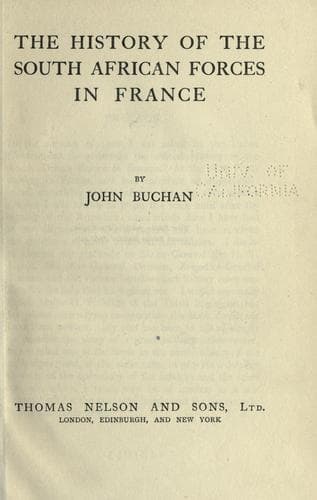
The history of the South African forces in FranceBuchan, John
History
The history of the South African forces in France
Buchan, John
South Africa. Army; World War, 1914-1918 -- Campaigns -- France; World War, 1914-1918 -- Regimental histories -- South Africa
On the 10th July B.G. Section, under the command of Lieutenant Covernton,
did a notably fine performance in laying and maintaining lines through
the intense barrages surrounding Mametz Wood. One of the first Valve
Amplifying Listening Sets supplied to the British forces for use in
intercepting enemy messages, by picking up weak leakage or induced
currents through earth or along parallel conductors, had been issued to
the Company for trial. As a large number of enemy cables ran through
Mametz Wood, and some extended to enemy territory behind it, favourable
results seemed probable. Lieutenant Collins took up the set, and tracing
the cables into No Man’s Land, tapped in there. Though, owing to the
excellent discipline of the enemy in obeying the limitations prescribed
for use of wire communication in the front line, no tactical messages
were obtained, this officer afterwards obtained recognition of his
courageous and enterprising efforts.
On the 14th July another general assault secured the line along the ridge
between Bazentin-le-Petit and Longueval. Accordingly, heavy batteries
were moved up as far as Caterpillar Wood in the valley in front of
Montauban, and on the 15th a party of B.E. section reconnoitred for lines
to Bazentin-le-Petit, in which village it was proposed to establish
H.A. Headquarters. The German reaction had, however, already begun, and
the party found the conditions in the village highly unsuited for a
headquarters, so much so that a warm infantry combat was proceeding in
the outskirts. High Wood had to be evacuated as too advanced to hold, and
the memorable struggle of the South African Infantry Brigade for Delville
Wood had begun. Nevertheless, over a mile of ground had been gained,
and the corresponding extension of communications necessarily taxed all
sections to their limit. The advanced headquarters of divisions moved up
to the famous dug-outs in the chalk under the ruins of Fricourt Château,
in which, thirty feet underground, with the amenities of electric light,
panelled walls, and artificial ventilation, the German Staff had dwelt
during the bombardment of the village. A twenty-four wire heavy route
was rapidly constructed by the 4th Army Signals from Méaulte to this
point, and thence to Mametz, in readiness for the advance, and the wire
light route built by the Company was extended by the Air Line Section
past Fricourt, up Death Valley, to Mametz Wood. The next deep advance
was not, however, to occur till two months later, as the corps front was
now becoming a salient, and it was necessary to clear the flanks and
broaden the base of the attack. Therefore, while the Anzac Corps and
III. Corps on the left, and the XIII. Corps succeeded by the XIV. Corps
on the right, hammered away round Pozières and Ginchy respectively, the
XV. Corps was engaged in continuous auxiliary attacks, and its heavy
artillery co-operated largely with the operations of the flanking corps.
Public-domain text, read in full here on John Shaqi.
Reviews
Reviews
No reviews yet
Be the first to share your thoughts on this work.
Elsewhere in the archive
Join the Discussion
Join the discussion
Sign in to leave a comment or review.
Sign InorCreate an account