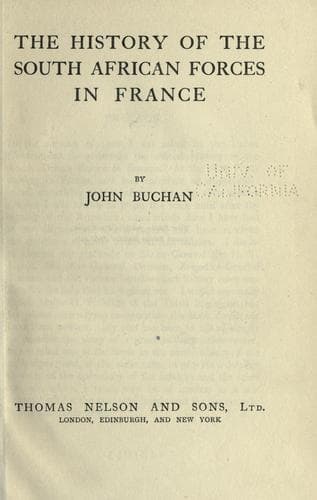
The history of the South African forces in FranceBuchan, John
History
The history of the South African forces in France
Buchan, John
South Africa. Army; World War, 1914-1918 -- Campaigns -- France; World War, 1914-1918 -- Regimental histories -- South Africa
Long before the Somme Battle, the exigencies of trench warfare had
altered the original organization of army corps. The corps had ceased to
be a unit composed of specific divisions, and divisions were no longer
affiliated permanently to one corps, but moved at frequent intervals
from quiet sectors to active ones to take part in an offensive, and
after a short period of heavy losses and extreme exertion would be
again withdrawn to another quiet sector or a training area for rest,
recruitment, and refit. Therefore, on a front like the Somme, a
continuous stream of divisions passed through the corps, each taking its
share of the fighting and being in turn relieved. As the Corps Signal
Company, like the brook, “went on for ever,” it had to fit each fresh
division into the frame of the existing communications as they chanced
to stand at the moment, and assist the divisional signals to pick up and
utilize the available lines. The organization had, also, to be elastic
enough to meet the requirements of administering anything from two to
seven divisions simultaneously. During the Somme, nineteen different
divisions passed through the XV. Corps, and as many of them went
through the furnace more than once, there were altogether fifty-three
divisional changes. What work this involved to the Corps Signal Company
in the transferring of lines, the directing of traffic, the continuous
alteration of records, and the supply of material can be readily imagined.
The excellence of the work of the B.E. Section with the Heavy Artillery
was recognized in a communication addressed to Major Harrison, in which
the Corps commander stated that he much appreciated the work done by
Lieutenant Ross and his party, and considered that the work of this
section was typical of the whole South African Signal Company. When
General Horne himself left the Corps at a later date, to take command of
the First Army, he had evidently seen no reason to alter his opinion of
the Company, for in taking leave of the A.D.A.S. he congratulated him on
commanding a unit second to none in France.
Public-domain text, read in full here on John Shaqi.
Reviews
Reviews
No reviews yet
Be the first to share your thoughts on this work.
Elsewhere in the archive
Join the Discussion
Join the discussion
Sign in to leave a comment or review.
Sign InorCreate an account