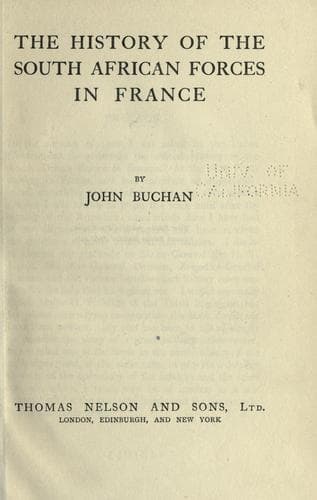
The history of the South African forces in FranceBuchan, John
History
The history of the South African forces in France
Buchan, John
South Africa. Army; World War, 1914-1918 -- Campaigns -- France; World War, 1914-1918 -- Regimental histories -- South Africa
Liaison lines had grown formidably in numbers. Direct lines were now
demanded not only between Heavy Artillery Headquarters and the Artillery
Headquarters of all divisions in line, but between the divisional
artilleries and the majority of the Heavy Artillery Groups. There had
been a great development of the service of Observation in the shape
of artillery aeroplanes, kite balloons, of which there were now three
sections attached to the Corps and Observation Groups of the R.E. Survey
battalion. Whenever possible lines were now required from these units,
not only to the artillery groups, but to the batteries specially assigned
for counter-battery work. To co-ordinate and render fully effective this
work of the systematic location and destruction or neutralization of
hostile batteries, a special staff, commanded by a colonel, had been
added to the H.A. Headquarters, and this staff, in its turn, required
additional direct lines and communication facilities to enable it to
function promptly and effectively.
The evil luck that, except in the initial push, caused every successful
attack to be followed by broken weather, still held good and hampered
all preparations for the assault on the next entrenched line; but by
herculean efforts the necessary organization for another general attack
on the 25th September was completed. Road conditions up to a certain
point forward were now beginning to improve under the triple influences
of the introduction of Décauville tramways for the conveying of the heavy
ammunition in the forward area, the extension of broad-gauge ammunition
railheads to Fricourt and Caterpillar Wood, and the removal of water
lorries from the roads by the completion of a vast system of pipe lines
extending back to the Ancre and the Somme through which the river water
was pumped after treatment in chlorinating plants.
On the 25th the intermediate German line, including Morval, Lesbœufs,
and Gueudecourt, succumbed, and the Corps front again advanced over a
mile. On the 26th the victory was completed by the Fifth Army’s capture
of Thiepval, and once again the roseate prospect of a great victory and
of reaching Bapaume before winter cheered the tired troops, and kept
the Signal Company’s hands full with preparations for forward moves of
all headquarters. The weather, however, intervened on the side of the
Germans, and breaking decisively on the 26th, remained miserably cold and
wet thenceforward, and largely stultified the heroic efforts repeatedly
made throughout October.
Public-domain text, read in full here on John Shaqi.
Reviews
Reviews
No reviews yet
Be the first to share your thoughts on this work.
Elsewhere in the archive
Join the Discussion
Join the discussion
Sign in to leave a comment or review.
Sign InorCreate an account