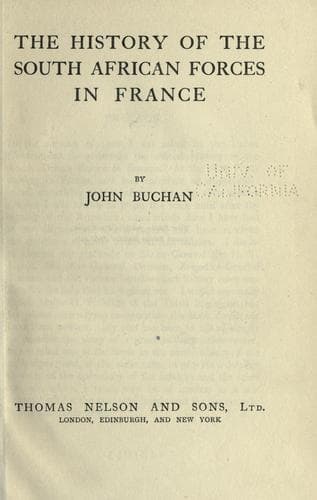
The history of the South African forces in FranceBuchan, John
History
The history of the South African forces in France
Buchan, John
South Africa. Army; World War, 1914-1918 -- Campaigns -- France; World War, 1914-1918 -- Regimental histories -- South Africa
The attack on 15th September proved highly successful and not too
costly in life, a depth of over a mile being made good, including the
villages of Courcelette, Martinpuich, and Flers. Communications held
well throughout the day, and the good liaison between infantry and
artillery so secured played an important part in the result. The recently
introduced Power Buzzers for transmitting high-power buzzer signals
through earth to be picked up by Valve Amplifying Receivers at distances
up to three thousand yards, were used with fair success in the advance.
These sets were controlled by the Wireless Section, but the forward
stations were manned by signallers of the attacking battalions. The
comparative inexperience and lack of special training of these signallers
prevented the best being got out of the instruments, but the limited
establishment of the Signal Service prevented any other procedure.
The advance rendered a further extension of the cable trench urgent, but
for the moment suitable cable for a permanent bury was not available.
Another section of trench, however, was dug immediately in order that
units might have the benefit of its protection in running temporary
field cables forward. This section extended from York Trench through
the corner of Delville Wood to Switch Trench, and the digging proved a
gruesome task, as Delville Wood and neighbourhood was a huge graveyard.
In the sides of the trench were visible more than one pitiful reminder
that our heroic comrades of the Infantry Brigade had fought and died
there. To prevent confusion and facilitate maintenance, the left-hand
side of the new trench was assigned to divisions and the right to the
Heavy Artillery, the Headquarters Signals of which prepared and erected
along the trench fixtures for cables in the shape of angle iron high-wire
entanglement pickets, each having a piece of two-inch by two-inch wood
screwed to it with a dozen diagonal slots cut in it for the cable.
The cutting and slotting of so many pieces—upwards of one thousand
five hundred—was a task beyond hand methods, but was accomplished in
three days by obtaining a power-band saw from a factory in Albert,
and connecting it up with the water wheel at Vivier Mill by a belt
extemporized from the driving bands of the cable wagon winding gears.
During this period occurred a noteworthy performance in rapid repair of
cable routes. The main cable trench about midnight received a direct hit
from a large shell, severing all communication; but fortunately a party
of B.E. section was returning down the trench from forward work, and
came on the shell crater soon afterwards. Though already worn out with a
long day’s work and struggling through the mud, they at once started to
dig up the cable ends, sending a man to summon assistance by tapping in
at the next test point in the trench, and succeeded in getting all the
forty-five pairs of wires rejointed and working again in _three hours_.
Public-domain text, read in full here on John Shaqi.
Reviews
Reviews
No reviews yet
Be the first to share your thoughts on this work.
Elsewhere in the archive
Join the Discussion
Join the discussion
Sign in to leave a comment or review.
Sign InorCreate an account