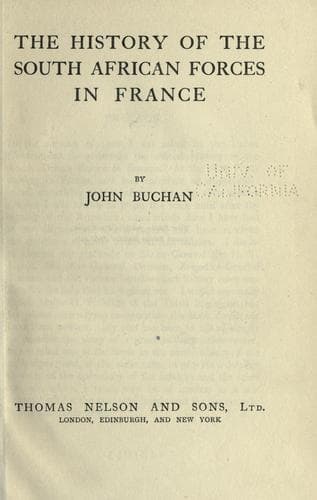
The history of the South African forces in FranceBuchan, John
History
The history of the South African forces in France
Buchan, John
South Africa. Army; World War, 1914-1918 -- Campaigns -- France; World War, 1914-1918 -- Regimental histories -- South Africa
Though the duties of the H.A. Signal Officer were somewhat reduced by the
appointment, in January, of a R.E. Signal Officer to each H.A. Group,
the commencement by the enemy of systematic counter battery work, in
imitation of the British methods initiated in the previous year, made
it more than ever difficult to keep the forward lines in continuous
operation. A scheme for the forward extension of the buried system, till
recently used by the French, was prepared under the greatest transport
difficulties, the drums having to be man-handled about half a mile
across country by night, and a portion of the material was got up to
Marrières Wood, next year the scene of the South African Brigade’s fine
stand in the March retreat. But the deep crust of frozen ground prevented
digging, and the important local attack of the 8th Division on the 4th
March on Fritz Trench above Bouchavesnes had to be carried through
without the assistance of the new buried communication, and as most of
the above-ground cables were cut, the first news of the assaulting troops
was brought by pigeon to the Corps Loft at Etinehem. The attack was fully
successful, and the effective use made by the artillery of the excellent
observation secured by it, no doubt expedited the general retirement of
the enemy in this sector.
A few days later symptoms of this retreat became obvious in the shape of
villages burning and large transport movements in the enemy back area.
The general withdrawal began on the 15th March, the enemy falling back
on the Corps front across the Canal du Nord. As the Fourth Army was not
destined to play a part in the spring offensive, it had been heavily
depleted both to swell the concentration northwards in preparation for
the coming Arras battle, and to take over additional ground from the
French, the sector on the XV. Corps right south of the Somme having
been occupied by the III. Corps during February. Apart, therefore, from
the tremendous transport difficulties due to continuous wet weather
succeeding the frost, and the methodical destruction of bridges, roads,
and railways, there was not sufficient strength to press the enemy
closely, but the advance was conducted methodically, touch with the enemy
rearguards on the Corps front being maintained by the Wiltshire Yeomanry
and the Corps Cyclist Battalion until a Cavalry Division could come up.
Public-domain text, read in full here on John Shaqi.
Reviews
Reviews
No reviews yet
Be the first to share your thoughts on this work.
Elsewhere in the archive
Join the Discussion
Join the discussion
Sign in to leave a comment or review.
Sign InorCreate an account