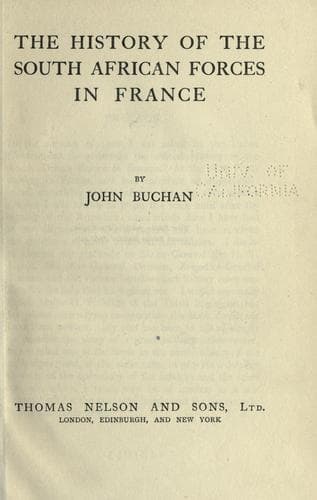
The history of the South African forces in FranceBuchan, John
History
The history of the South African forces in France
Buchan, John
South Africa. Army; World War, 1914-1918 -- Campaigns -- France; World War, 1914-1918 -- Regimental histories -- South Africa
The Signal Company’s share in the work was first to maintain direct touch
between the Corps Staff and the advanced troops, for which purpose D.R.’s
were attached to the cavalry, but by a special effort of B.E. section
direct telephone communication was soon secured and maintained. Secondly,
the main communication network had to be extended forward at the same
rate as the advance, and, as a counter-attack was very possible, the
full organization for position warfare accompanied the Corps. The Signal
difficulties were doubled on the 25th March, by the sudden withdrawal
from line of the XIV. Corps on the right and the consequent extension of
the already wide Corps frontage which then stretched from Péronne to Le
Transloy.
The Imperial Signal Sections attached for assistance at intervals during
the winter had been withdrawn, and, worst of all, the needs of the
fighting fronts northwards entirely shut off for a time the supply of
line construction material. Consequently, before a single pole or wire
could be erected, it had to be released from service in rear, salvaged,
and transported forward by the company’s lorries over extremely bad and
congested roads. Much heavy material had again to be relayed forward
over tracks impassable to lorries by teams from the cable sections, and
finally carried on the sappers’ shoulders over shell-shattered ground
impassable even for wagons. Under such handicaps, and in the teeth of
continuous blizzards of snow, sleet, and rain, which continued till
the end of April, over forty miles of poled route, including much of
a heavy permanent nature carrying twenty-four wires, was erected, and
two successive moves of the Headquarters of Corps and all subordinate
formations accomplished without any loss of communication. The skill,
endurance, and ready zeal of the A.S.C. Motor Transport drivers attached
to the Company played a great part in the results achieved. They had
never failed to meet the severe calls made upon them from time to time
during the Somme fighting, but now both the distances and the masses of
material to be moved were greater, and the road conditions but little, if
any, better.
Early in April the advance reached its limit, and was definitely held
up in front of La Vacquerie and Havrincourt—outlying strong points of
the Hindenburg Line. On the 17th, Corps Headquarters was established
in hutments and tents near Haute-Allaines, after a short interval at
P.C. Chapeau. Then the weather at last broke, and with a genial spring
sun overhead, a rapidly drying country underfoot, and good news coming
through from the Arras front, life under canvas, even in this devastated
zone, became pleasant.
Public-domain text, read in full here on John Shaqi.
Reviews
Reviews
No reviews yet
Be the first to share your thoughts on this work.
Elsewhere in the archive
Join the Discussion
Join the discussion
Sign in to leave a comment or review.
Sign InorCreate an account