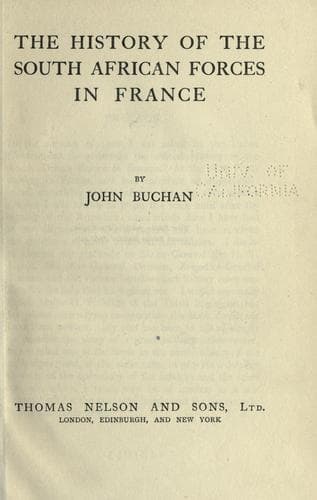
The history of the South African forces in FranceBuchan, John
History
The history of the South African forces in France
Buchan, John
South Africa. Army; World War, 1914-1918 -- Campaigns -- France; World War, 1914-1918 -- Regimental histories -- South Africa
The movement of Corps Headquarters to Bray-Dunes was effected on the 29th
June, having been somewhat expedited by one of the periodical shellings
of Dunkirk by a German long range gun. On the morning of the 27th a
twelve-inch shell dropped on the Corps Offices in the Casino at Malo,
and inflicted a number of casualties—luckily for the Company, it just
missed the Signal Office. A few days later the Heavy Artillery Quarters
moved back to the village of Oost Dunkirk, about six thousand yards from
the line, and occupied the Villa Rosarie. During the first week in July
a considerable increase in hostile shelling was noted, but not to an
alarming extent, though a direct hit on the H.A. sections’ store rooms
put a few telephones _hors de combat_; and no immediate operations were
anticipated.
The enemy, however, had decided to nip our attack in the bud by taking
the initiative himself, and had only delayed to complete a crushing
artillery concentration. Thus about 9.30 a.m. on the 10th July, when
many batteries were not yet in position and many others not yet ready
for action, an intense bombardment dropped over the whole Corps area up
to nine thousand yards behind the front line. With the most admirable
accuracy and thoroughness, every village and battery position was
searched, and every road of approach swept by heavy shell fire. Forward
communications failed almost at once, the bridges across the Yser below
Nieuport were destroyed, the breastwork trenches melted away before the
storm of high explosive, and when the infantry assault was delivered
about 7 p.m. few survivors of the Brigade of the 1st Division that
held the trenches across the Yser in front of Nieuport Bain, remained
to resist, and the German front line was established on the Yser bank
in this sector. On the other flank, at Lombartzyde, the 32nd Division
managed by desperate fighting to retain most of the ground in front of
Nieuport, but the main German object was achieved; the approaches to the
bridgehead were now limited to the single entry of Nieuport, and the
bridgehead itself was so reduced in area as to make a serious attack in
force a very desperate venture.
Public-domain text, read in full here on John Shaqi.
Reviews
Reviews
No reviews yet
Be the first to share your thoughts on this work.
Elsewhere in the archive
Join the Discussion
Join the discussion
Sign in to leave a comment or review.
Sign InorCreate an account