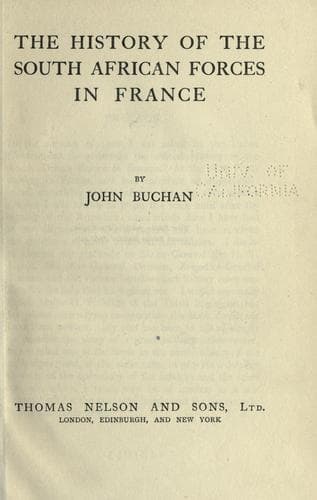
The history of the South African forces in FranceBuchan, John
History
The history of the South African forces in France
Buchan, John
South Africa. Army; World War, 1914-1918 -- Campaigns -- France; World War, 1914-1918 -- Regimental histories -- South Africa
This day was naturally a most trying one for the Signal _personnel_.
Nearly all wire communication was lost in the first two hours, and all
formations from Corps downwards had to fall back on despatch riders and
runners. Very fine work was done by the Company’s despatch runners on
the shell-swept roads, while the sections strove to patch up and keep
going the vital command lines. Thanks to cool and quick repair work by
the sappers, and to the use of a short piece of cable trench completed
on the previous day, touch was kept with most of the Heavy Artillery
Groups continually throughout the day. The observation lines could not,
however, be kept going, and thus the batteries not put out of action
were blinded, and could not effectively support the infantry across the
river. Oost Dunkirk village suffered heavily, and after nightfall the
H.A. Staff were forced to move into the sand dunes half a mile to the
flank, when temporary cables were run back to the signal office at the
Villa Rosarie, which enjoyed protection in a sandbagged shelter behind
the house. As this shelter was the only place in the village enjoying any
degree of protection, it became during that day and night a temporary
aid post for wounded and a refuge for the few remaining villagers. Amid
these conditions, and deafened by the crashing explosions of the shells
among the houses, the telephonists managed to carry on with wonderful
efficiency for twenty-four consecutive hours. Conditions at Coxyde Signal
Office with B.G. section were very similar.
Much to the general surprise, the attack was not resumed on the following
day, and while every nerve was strained to get the existing lines
restored, work on the new communications began and was pressed forward
night and day. The buried scheme originally planned provided for four
forward trenches, one along the sea coast, one through the dunes, one
partly French and already dug through the polder area, and one consisting
of cable laid in the bed of the Nieuport Canal—all to be connected by a
lateral trench running through H.A. Headquarters, which was to become the
chief maintenance and test point. Lieutenant Collins with B.E. section
and a rapidly increasing number of Imperial sections, loaned from Army
Signals, was entrusted with this work, assisted by Lieutenant Dobson. In
view of the experiences of the 10th, two additional trenches were added
to the plan, one from a main open route junction point behind Coxyde,
forward along the fringe of the dunes to H.A. Headquarters, and the other
along the sea-beach above highwater mark from Corps Headquarters at
Bray-Dunes to the same point.
Public-domain text, read in full here on John Shaqi.
Reviews
Reviews
No reviews yet
Be the first to share your thoughts on this work.
Elsewhere in the archive
Join the Discussion
Join the discussion
Sign in to leave a comment or review.
Sign InorCreate an account