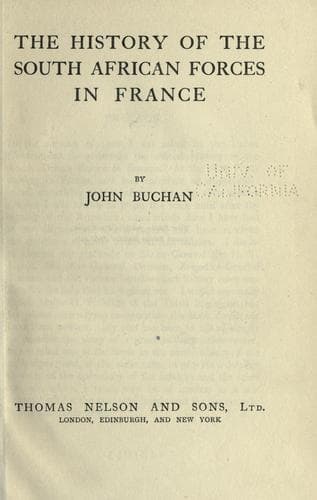
The history of the South African forces in FranceBuchan, John
History
The history of the South African forces in France
Buchan, John
South Africa. Army; World War, 1914-1918 -- Campaigns -- France; World War, 1914-1918 -- Regimental histories -- South Africa
During this period the sappers stationed at the forward test points had
a most trying experience. Owing to the frequent breakdowns, they were
perpetually working on the cable trenches by day and by night, employed
in testing and substituting lines. The frequent use of gas shell made
it necessary that at their isolated points they should secure the gas
blankets of their dug-out entrances at night, and this inevitably
produced an atmosphere little inferior to the gas itself. Two concreted
test points in the “polder” area, taken over from the French, were
conspicuous after shelling had destroyed all arboreal cover. The Germans
apparently decided that these were gun positions, and favoured them with
special attention, managing finally to secure three direct hits—two
innocuous, however unnerving to the inmates; but the third on P.C. 6
burst square on the roof, and though only slightly bending the steel
rails embedded in the concrete, killed a sapper of B.F. section inside.
One small dug-out on the canal bank, P.C. 18, disappeared altogether
after an eleven-inch howitzer bombardment of a neighbouring battery, but
fortunately there was no occupant at the time.
Corps Headquarters moved to La Panne at the beginning of September;
but the location had evidently been given away by a spy, as it was
heavily shelled by a long range gun a fortnight later, and consequently
retransferred to Bray-Dunes. Though as the autumn drew on activity in
the sector died down, all ranks had reason to welcome the relief of the
Corps by the XXXVI. French Corps that commenced on the 19th November. On
the 20th the Headquarters of the Company, under Captain Dingwall, who had
been acting as A.W. Signals since September during Lieutenant-Colonel
Harrison’s absence on sick leave, moved to Hinges near Béthune, and
commenced to take over from the XI. Corps—then under orders for Italy—a
sector between Béthune and Armentières.
THE LYS AREA.
Public-domain text, read in full here on John Shaqi.
Reviews
Reviews
No reviews yet
Be the first to share your thoughts on this work.
Elsewhere in the archive
Join the Discussion
Join the discussion
Sign in to leave a comment or review.
Sign InorCreate an account