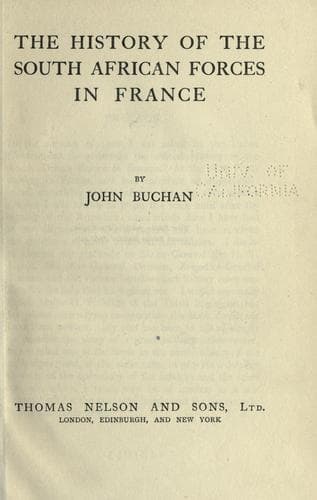
The history of the South African forces in FranceBuchan, John
History
The history of the South African forces in France
Buchan, John
South Africa. Army; World War, 1914-1918 -- Campaigns -- France; World War, 1914-1918 -- Regimental histories -- South Africa
After some readjustments of frontage in December, the XV. Corps settled
down to hold the sector in front of the Lys, from Houplines to Laventie,
with the Portuguese Corps on the right and the Anzac Corps on the left.
In January 1918 Corps Headquarters were shifted from Hinges to La
Motte-aux-Bois in front of the Forest of Nieppe, and Heavy Artillery,
with the H.A. and B.E. sections, to Estaires, where 51 Air Line was
already established. A further reorganization of the Company now took
place. As cable sections rarely, if ever, performed the mobile work
for which their horse transport was provided, the decision was reached
to disband one cable section in each Corps, to reduce the strength of
the Corps air line section to forty-two all ranks with one heavy and
two light lorries, and with the surplus _personnel_ so accruing form
an additional air line for each Corps. B.G. section was, accordingly,
converted into the nucleus of the new 91 Air Line Section, to which
Lieutenant Dobson was appointed. At the same time, “Q” Wireless Section
became an integral portion of the Signal Company, and was taken over by
Lieutenant McArthur, with 2nd Lieutenant FitzGeorge as second officer,
the Imperial _personnel_ being rapidly replaced by South Africans. A
second officer was also authorized for the Heavy Artillery Section,
and Lieutenant M. Cohen, who had been attached to a brigade of the 8th
Division since his arrival from England in November 1917, was appointed.
The communications here were such as would serve on a thinly held and
lightly shelled front. Buries were few and becoming inefficient with age;
the light open-wire routes which formed the bulk of the communication
were run close up to the front line. The defection of Russia made it
certain that the Allies would be thrown on the defensive in the spring;
and as the Lys covered Hazebrouck and the direct route to Calais, it was
probable that the sector would become a main front of attack. Ample and
secure communications were, therefore, a first necessity, and a complete
scheme was prepared on a scale of magnitude and thoroughness which
surpassed any previous performance. All trenches were to be seven feet
deep and carry no less than thirty pairs of wires.
Public-domain text, read in full here on John Shaqi.
Reviews
Reviews
No reviews yet
Be the first to share your thoughts on this work.
Elsewhere in the archive
Join the Discussion
Join the discussion
Sign in to leave a comment or review.
Sign InorCreate an account