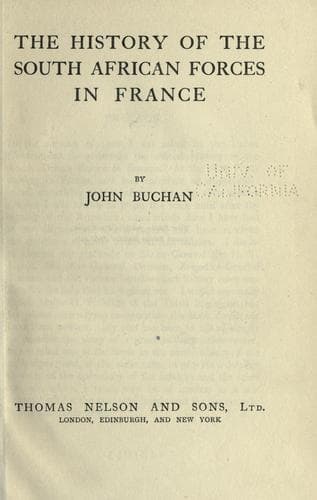
The history of the South African forces in FranceBuchan, John
History
The history of the South African forces in France
Buchan, John
South Africa. Army; World War, 1914-1918 -- Campaigns -- France; World War, 1914-1918 -- Regimental histories -- South Africa
The series of successful minor operations carried out by the Corps in
July and August, including the capture of Méteren, and the devastating
effect of our superior and incessantly active artillery, no doubt
quickened the German decision to evacuate the Lys salient. This
evacuation commenced at the end of August, and thenceforward all ranks
were occupied in the rapid restoration of communications through the
devastated area, now as broad as the old Somme battlefield. An attempt
was made to utilize the old buries laid down by the XV. and other Corps
before the retreat; but these were too effectively destroyed by the
enemy to admit of rapid restoration.
After the successful attack of the Belgian and Second British Armies at
the end of September, in which the XV. Corps co-operated on the right
flank, headquarters were moved to St. Jans-Cappel on the 4th October, and
on the 21st, to Mouvaux, near Tourcoing, following the rapid retreat of
the enemy to the Scheldt. On this occasion a fast piece of work was done
by 91 Air Line and B.E. Cable Section, two lines being completed across
the Lys to the new headquarters—a distance of nearly twenty miles—in one
day.
The Signal portion of the preparations for forcing the passage of the
Scheldt filled the period up to the 10th November; but as the enemy
retired during the night, and the Armistice was proclaimed the following
day, they proved unnecessary.
The Corps was not selected to accompany the advance to the Rhine, and
so it fell to the lot of B.E. Section on the 12th to lay the last and
farthest forward cable in France, from the Scheldt, crossing at Pecq to
an observation point on the eastern side.
APPENDIX III.
THE MEDICAL SERVICES.
When the South African Expeditionary Force was organized on the
termination of the campaign in German South-West Africa, Colonel P. G.
Stock was appointed S.M.O., and in addition to the South African Medical
Corps _personnel_ who volunteered for regimental duties, arranged for
the mobilization of one Field Ambulance and one General Hospital. The
former, under the command of Lieutenant-Colonel G. H. Usmar, S.A.M.C.,
assembled at Potchefstroom with the 1st South African Infantry Brigade;
while the General Hospital was formed at Wynberg, the _personnel_
being largely composed of volunteers from the staffs of No. 1 General
Hospital, Wynberg, and No. 2 General Hospital, Maitland, and included
representatives from each of the four provinces of the Union. It
subsequently provided the _personnel_ for the Depot in England, and the
South African Military Hospital at Richmond, which was afterwards built
and organized.
No hospital equipment was available in South Africa, but the official
Advisory Committee on Voluntary Aid, of which Sir Thomas Smartt was
chairman, met the difficulty by voting £15,000 to purchase it on arrival
in England, and a further £1,500 to augment the equipment taken by the
Field Ambulance.
Public-domain text, read in full here on John Shaqi.
Reviews
Reviews
No reviews yet
Be the first to share your thoughts on this work.
Elsewhere in the archive
Join the Discussion
Join the discussion
Sign in to leave a comment or review.
Sign InorCreate an account