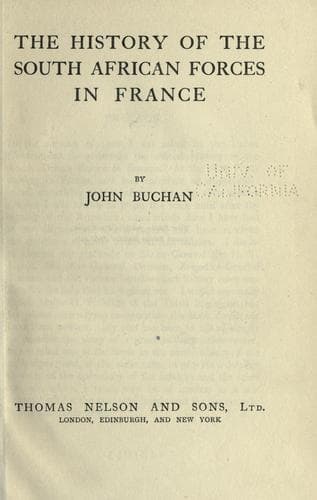
The history of the South African forces in FranceBuchan, John
History
The history of the South African forces in France
Buchan, John
South Africa. Army; World War, 1914-1918 -- Campaigns -- France; World War, 1914-1918 -- Regimental histories -- South Africa
“In the many bright spots of the XV. Corps, I have always
maintained, and always will maintain, that the Signal Service
was far away the best Signal Service of any other organization
in France. Not only was there a very thorough grasp of the
work, but always—what was so pleasant to find—there was a
desire to go out of your way to help. It is with the greatest
pleasure that I write to say how much I always appreciate
having the South African Signal Company in the XV. Corps. They
were not only highly efficient in all departments of this
work, but I can honestly say they were the most energetic,
hard-working, well-disciplined, and courteous body of men that
I have come across in my experience of the Army.
“I always felt in dealing with you that nothing was ever too
much trouble for you or your men, and that no matter how
exacting the demands made upon you—and they were often very
heavy indeed—no effort would be spared to carry them through
successfully. Never were we let down during the most trying
times—on the Somme, on the coast, or on the Lys. During the
enemy’s attack on the Lys in April 1918, the truly remarkable
way in which all our communications held out for three days,
till we were compelled to abandon La Motte, greatly facilitated
the exercise of the command of the Corps during those difficult
days, and was an eloquent testimony of the thoroughness and
skill with which the work of preparation had been carried out.”
The final holding up of the Germans at Kemmel on the 28th April made it
possible to commence effective work on the defences at Hazebrouck, and
during the next few months successive lines of trenches and belts of wire
came into existence, and seamed the country as far back as St. Omer.
The Company’s share in these preparations was work on a buried cable
scheme which started early in May, and gradually developed as labour and
material were obtainable, until, when the advance began, a network of
trenches extended across the whole Corps area for 13,000 yards in depth
and 7,000 in breadth, embodying thirty miles of seven-foot deep trench
and nearly 1,200 miles of pair cable. This work, though never tested by
another offensive, was of great value during the prolonged artillery
duel which followed the Battle of the Lys. The open-wire routes were
continuously shelled or bombed down, for in this sector, as on the coast,
aeroplane bombing was a nightly event.
Public-domain text, read in full here on John Shaqi.
Reviews
Reviews
No reviews yet
Be the first to share your thoughts on this work.
Elsewhere in the archive
Join the Discussion
Join the discussion
Sign in to leave a comment or review.
Sign InorCreate an account