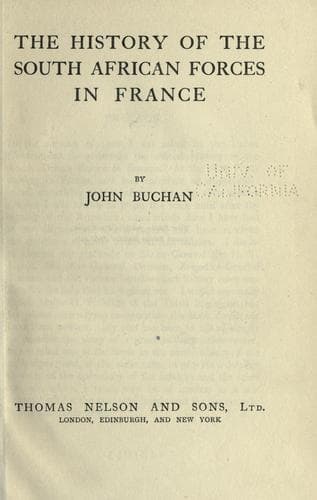
The history of the South African forces in FranceBuchan, John
History
The history of the South African forces in France
Buchan, John
South Africa. Army; World War, 1914-1918 -- Campaigns -- France; World War, 1914-1918 -- Regimental histories -- South Africa
Until early in August the hospital was without its own nursing
Sisters—these services being performed by members of the Q.A.I.M.N.S.,
the Canadian Military Nursing Service, and English V.A.D.’s, who did all
that hard work and devotion to duty could do to make up for the shortage
in number. On 5th August, however, Matron Creagh and twenty-one members
of the S.A.M.N.S. arrived from England, and the greatest difficulties in
this respect were over. The nurses’ camp had to be pitched in the wooded
ground of a château some little distance off; but when the storm clouds
rolled up the valley, and the winter rains set in, they had perforce to
be billeted in the town until the huts which were contemplated for them
were completed.
Situated as it was at the advanced base in a convenient position for
their reception, the hospital, during the autumn of 1916, received a
large number of wounded direct from the Somme battlefield. Amongst the
earliest admissions in July 1916 were South Africans wounded at Delville
Wood, and towards the end of July General Lukin was one of the first
officer patients.
The most severely wounded journeyed by specially-fitted hospital barges,
which, from the casualty clearing stations around Corbie, floated down
the Somme to Abbeville, where the patients were disembarked and taken by
motor ambulances to the hospital. The use of barges was restricted to
those cases who were unable to stand the strain of a journey by train.
Usually they travelled in pairs, but on more than one occasion during
the autumn of 1916 patients from six barges were admitted during the
twenty-four hours. Towards the end of 1916 the barges ceased running, as
the winter rains had rendered the passage down the Somme too dangerous,
and they were not again employed, as the advance in the spring of 1917
carried the fighting away from the river.
Fortunately, during the first few weeks after the arrival of the unit in
France, the weather was fine, but even then difficulties were experienced
in regard to the main road leading to the hospital. For part of the way
this was formed by “sleepers,” but as the supply of them gave out beech
planking had to be substituted. This quickly “warped,” and becoming
displaced with the constant traffic, was always a source of trouble, as
the underlying chalk during the dry weather quickly powdered to a fine
dust, and later, when the rains set in, turned into a particularly greasy
form of mud.
As soon as materials and labour became available, the “sleeper track”
was continued, and a large “triage” constructed on which the ambulance
wagons could turn; but it was not until many months later that it
became possible to build a macadamized road connecting the hospital with
the Route d’Amiens. The old entrance was then utilized as an exit for
empty wagons, and the original signboard of the hospital, on which Major
Merritt had painted the Springbok badge, was removed to the new entrance.
Public-domain text, read in full here on John Shaqi.
Reviews
Reviews
No reviews yet
Be the first to share your thoughts on this work.
Elsewhere in the archive
Join the Discussion
Join the discussion
Sign in to leave a comment or review.
Sign InorCreate an account