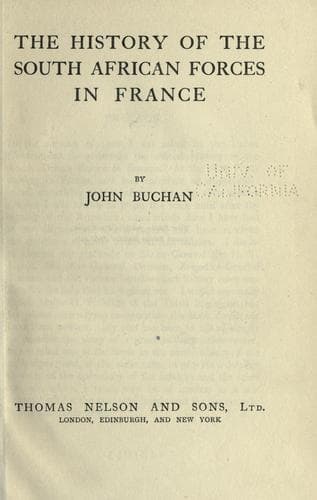
The history of the South African forces in FranceBuchan, John
History
The history of the South African forces in France
Buchan, John
South Africa. Army; World War, 1914-1918 -- Campaigns -- France; World War, 1914-1918 -- Regimental histories -- South Africa
The total admissions for the year 1917 were 19,109, of which 7,613 were
battle casualties and 11,496 were sick. During the same period there were
18,277 discharges. Of this number 2,638 were returned to duty, 4,253
were transferred to convalescent depôts, 8,749 were evacuated to the
United Kingdom, and 2,637 were transferred to hospitals at other bases in
France. One thousand two hundred and ten major operations were performed
during the year 1917. For the same period, including eleven cases brought
in for burial, there were 181 deaths in the hospital. Of these 128
were due to wounds—a percentage of 1.68; and 53 were due to sickness—a
percentage of .46. The death rate from all causes for this year worked
out at .94 per cent.
Promises of hutted accommodation, both for patients and personnel, were
current for at least twelve months. Nothing, however, happened in this
direction, except that an administration block and a new kitchen for the
hospital were built; and in October 1917, with keen remembrances of the
previous winter, it was decided to erect such huts as was possible with
labour supplied by the staff of the hospital. A start was made, with the
idea of housing the men of the company who were over forty years of age,
and a hut was built, using discarded telegraph poles as the principals,
covered with corrugated iron and lined with wood—the lining being bought
from funds provided by the South African Hospital and Comforts Fund at a
cost of, approximately, £120.
Stimulated by the success of the first, the building of the second hut
was then taken in hand; and eventually, with the assistance of the
engineer services, comfortable quarters for all the personnel were
erected. In January 1918 six hospital “Adrian” huts were erected, but
were not completed until the end of March, chiefly owing to the lack
of labour and uncertainty as to whether the hospital would have to
be evacuated. Three double “Nissen” hospital huts were subsequently
added—the last not being quite finished when the armistice was signed.
The erection of a further eight, which would have completed the building
programme of the hospital, was cancelled.
For the first few months all traffic to the hospital had to pass through
a neighbouring hospital—No. 2 Stationary, R.A.M.C.—this being not only
inconvenient, but leading to congestion. Later, a metalled road was made
through the South African Hospital leading to the Amiens road and looping
within the hospital. This meant that traffic was easily managed, and made
the handling of convoys infinitely easier. In the summer of 1918 a tarred
surface was put on to this road, which proved a great help in keeping
down the dust.
The necessity for a special railway siding for the three large hospitals
in this area to avoid the long, rough, and frequently interrupted
journeys by ambulance from and to the main station was also met.
Public-domain text, read in full here on John Shaqi.
The history of the South African forces in France — John Shaqi
Reviews
Reviews
No reviews yet
Be the first to share your thoughts on this work.
Elsewhere in the archive
Join the Discussion
Join the discussion
Sign in to leave a comment or review.
Sign InorCreate an account