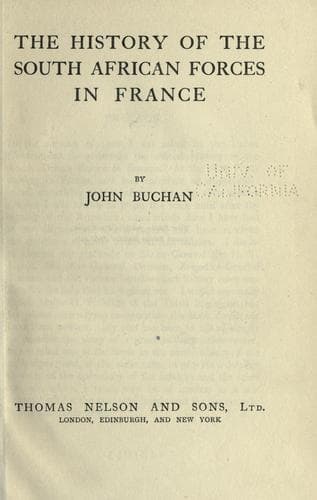
The history of the South African forces in FranceBuchan, John
History
The history of the South African forces in France
Buchan, John
South Africa. Army; World War, 1914-1918 -- Campaigns -- France; World War, 1914-1918 -- Regimental histories -- South Africa
Early in 1918 the War Office, seeing that the Richmond Military Hospital
was almost entirely filled with South African patients, proposed to the
Committee that the South African and the Richmond hospitals should be
amalgamated, the combined hospitals to be known as the South African
Military Hospital. The Committee readily agreed, and the two hospitals
were completely amalgamated on July 1, 1918.
The enlarged hospital provided 1,098 beds; but even this was not
sufficient, and 250 emergency beds were added by billeting patients in
the neighbourhood. In addition, four auxiliary hospitals were attached,
bringing the total number of beds to 1,321, or, including billets, 1,571.
The Park section of the combined hospitals stood on an enclosed site of
about twelve acres, the actual area of the building being about two and
one-third acres. The construction throughout was of timber with felt
and weather-board linings on the outside, and asbestos board-sheeting on
the inside of the walls and ceilings of all wards and principal rooms.
A special feature of this section was the bath ward, with six fire-clay
continuous baths for the treatment of patients suffering from severe
wounds.
The Grove Road extension was a brick building, and consisted for the most
part of modern infirmary wards supplemented by additional wards in old
buildings.
The equipment of the Park section was entirely provided by the Committee,
while that of the Grove Road section was found by the Board of Guardians
and the War Office, and was only where necessary supplemented by the
Committee.
Towards the end of 1916 the Committee offered the privilege of naming a
bed in the hospital to any persons or institutions making a gift of £25,
and of naming a ward for a donation of £600. The appeal resulted in 99
beds and 8 wards being thus named, approximately 265 of the beds being
the gifts of schools in South Africa, the organization for these being
initiated and carried out by Mr. Maskew Miller of Cape Town.
The principal corridors and rooms in the hospital were named after
well-known streets or places in South Africa, all the principal towns
in the Union being represented. The result of this, and of placing the
tablets over the beds, was that familiar names greeted the South African
visitor—a happy idea on the part of the Committee, and one which was much
appreciated by the sick and wounded of the contingent.
The Committee expended approximately £45,000 on building the hospital and
its extensions, and £19,000 on equipment. The former figure, however,
includes a sum of approximately £2,000 expended in erecting a concert
hall and certain workshops, while the latter figure includes considerable
sums spent on replacements. That the money was well spent is shown by
the fact that the hospital was always regarded as one of the model war
hospitals in the United Kingdom.
Public-domain text, read in full here on John Shaqi.
Reviews
Reviews
No reviews yet
Be the first to share your thoughts on this work.
Elsewhere in the archive
Join the Discussion
Join the discussion
Sign in to leave a comment or review.
Sign InorCreate an account