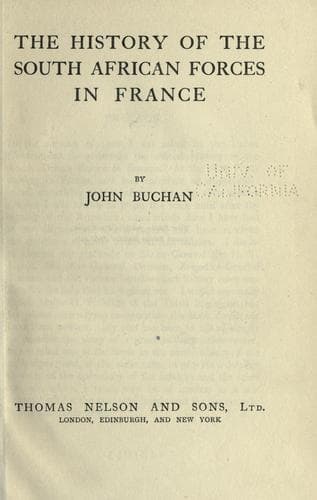
The history of the South African forces in FranceBuchan, John
History
The history of the South African forces in France
Buchan, John
South Africa. Army; World War, 1914-1918 -- Campaigns -- France; World War, 1914-1918 -- Regimental histories -- South Africa
The South African Vocational Training Scheme was carried on side by side
with the work of the hospital, and was successful both in improving the
mental attitude—especially of limbless men—and in training many disabled
men of the Contingent who would otherwise have been unproductive to the
community.
The cost of the erection of the workshops—amounting to £2,335—was
borne by the South African Hospital and Comforts Fund and the
Governor-General’s Fund.
Much of the equipment was either given or lent, but about £1,200
had to be expended to obtain such tools and appliances as could not
otherwise be obtained. The latter expenditure was defrayed by the
Governor-General’s Fund. The scheme also necessitated the hiring of four
houses in the vicinity of the hospital for housing students who had been
discharged from hospital; the cost of the equipment of these, amounting
approximately to £1,400, was also met by the two funds.
These hostels were managed by a small committee appointed by the General
Committee. The expenditure on rents, rates, and taxes for the hostels
was shared by the local fund and the Governor-General’s Fund, but all
other expenditure was met by the sub-committee which received through
the High Commissioner the sum of £1 per week for each inmate. This sum
represented a ration allowance of 1s. 9d. per head per diem received
from Defence Votes, the balance being made up by the Governor-General’s
Fund. The Union Government also made itself responsible for the pay and
allowances of the inmates, and entirely relieved the Imperial Government
of all financial responsibility for the period during which the men were
undergoing training after discharge from hospital. The number of crippled
men who attended classes since their commencement was 393. Of these 167
remained on October 31, 1918, and 226 had left. Of those remaining, 112
were out-students—that is, men discharged from hospital—and 55 were
patients still in hospital. The number of out-students dealt with was
215, of whom 103 have left.
The school was at first under the direction of Mr. Charles Bray, but
on his resignation owing to ill-health, Staff-Sergeant Newell, B.Sc.,
of the S.A.M.C., and in civil life on the staff of the Natal Education
Department, was appointed as educational organizer. He was subsequently
granted honorary commissioned rank in the Union Defence Force. The
propaganda work in the wards and the ward teaching were in the hands of
Miss Edith Hill, also of the Natal Education Department.
The hostels for housing out-students were managed by a matron—Mrs.
Lennox, of Lovedale—and a staff of ladies, whose efforts were attended
with every success.
Public-domain text, read in full here on John Shaqi.
Reviews
Reviews
No reviews yet
Be the first to share your thoughts on this work.
Elsewhere in the archive
Join the Discussion
Join the discussion
Sign in to leave a comment or review.
Sign InorCreate an account