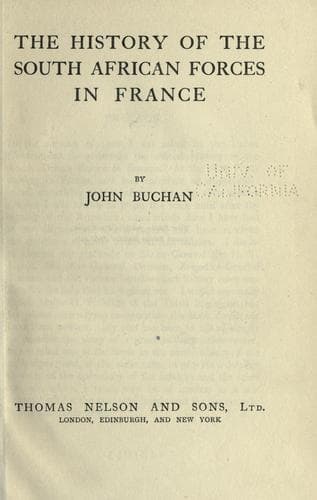
The history of the South African forces in FranceBuchan, John
History
The history of the South African forces in France
Buchan, John
South Africa. Army; World War, 1914-1918 -- Campaigns -- France; World War, 1914-1918 -- Regimental histories -- South Africa
Towards the end of February Lieutenant-Colonel J. D. Anderson (an officer
who had considerable experience in transport work) was asked to take
command, and to arrange for the recruiting and organization of the eight
companies. Kimberley was selected as the most convenient centre for
mobilization, and De Beers Corporation gave the use of its Nos. 1 and 3
Compounds. These had hutting accommodation for approximately two thousand
men. They were provided with a hospital, kitchens, washing-rooms—in
fact everything required—and there is no doubt that the loan of these
compounds not only facilitated mobilization and saved a great deal of
expense, but probably accelerated the departure of the contingent by at
least two months. Lieutenant-Colonel Wynne was appointed camp commandant,
with Captain MacKeurton as paymaster, and Captain Cooper as officer in
charge of the Records, and by the 12th March everything was in readiness
for recruiting to begin.
The results were at first disappointing, as recruiting for the Cape
coloured battalions for service in German East Africa was at this time
being undertaken, and recruiting committees for this purpose were at work
at all the principal centres in South Africa. In addition there were
many questions, such as the appointment of coloured N.C.O.’s, increased
rates of pay, the rejection of all coloured drivers other than Cape
coloured drivers, recognition by the Governor-General’s Fund, and other
details, all of which had to be settled before the Coloured Recruiting
Committees would lend their assistance. There was also a lack of Cape
Auxiliary Horse Transport officers to conduct a special recruiting
campaign. However, these difficulties were soon overcome, and recruiting
proceeded with great rapidity. Johannesburg, where Captain Barlow,
Captain and Chaplain Rogers, and Lieutenant Graham Moore inaugurated a
vigorous recruiting campaign; Cape Town, where Lieutenants Gillam and
Sawyer, Second-Lieutenant Tracey, S.S.M. Simmons, and C.S.M. Creagh met
with considerable success; and Knysna, with Second-Lieutenant Anderson
and C.Q.M.S. Steytler as recruiting officers, each produced five hundred
recruits in a short time.
At the beginning the amount of clerical work entailed was very heavy, the
work being increased owing to the necessity of having to reject a large
number of drivers who were attested but subsequently found unsuitable.
Every officer, warrant officer, and N.C.O., however, assisted the
Records’ officer to such an extent that by the middle of April 1,500 men
were ready to leave for overseas. Unfortunately, shipping could only be
found for 867, and these sailed in the _Euripides_ on the 20th April.
These were shortly followed by drafts under the command of Majors Jenner
and Barnard, and a reinforcement draft under Lieutenant Smith.
Public-domain text, read in full here on John Shaqi.
Reviews
Reviews
No reviews yet
Be the first to share your thoughts on this work.
Elsewhere in the archive
Join the Discussion
Join the discussion
Sign in to leave a comment or review.
Sign InorCreate an account