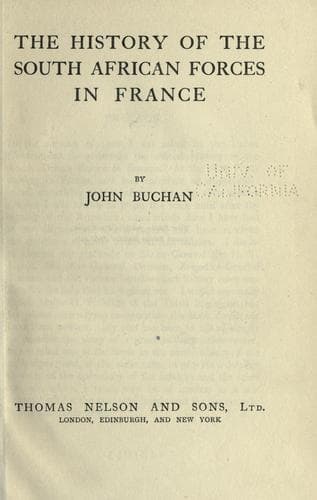
The history of the South African forces in FranceBuchan, John
History
The history of the South African forces in France
Buchan, John
South Africa. Army; World War, 1914-1918 -- Campaigns -- France; World War, 1914-1918 -- Regimental histories -- South Africa
On the arrival of the first detachment in France on 23rd May, the
Director of Transport decided that the contingent should release for
other service, and take the place of, the Army Service Corps _personnel_,
forming the following companies:—
No. 22 Auxiliary Horse Transport Company, A.S.C., stationed at
Dunkirk and Calais.
No. 5 Auxiliary Horse Transport Company, A.S.C., stationed at
Boulogne.
No. 2 Auxiliary Horse Transport Company, A.S.C., stationed at
Havre.
No. 8 Auxiliary Horse Transport Company, A.S.C., stationed at
Rouen.
No. 10 Auxiliary Horse Transport Company, A.S.C., stationed at
Rouen.
No. 11 Auxiliary Horse Transport Company, A.S.C., stationed at
Rouen.
Arrangements were also made for a base depot to be established at Havre.
The reorganization was commenced at once, one company of the first
draft going to Calais and the two others to Rouen. As other drafts
arrived they were sent to the base depot for three weeks, where they
were equipped, and went through a course of training before being
distributed to the various A.S.C. companies. Thus by the 31st August the
Cape Auxiliary Horse Transport detachments had released the whole of the
white _personnel_ of six companies of the Army Service Corps, with the
exception of five officers and a certain number of warrant officers and
N.C.O.’s, whose services it was proposed permanently to retain, while
after a few months in France the reorganized companies were all commanded
by officers of the detachment.
Though the men did very excellent work at the base posts, Colonel
Anderson felt that there were strong arguments in favour of them being
moved to divisional trains or Army Auxiliary Horse Transport companies
actually working in the army areas. The arguments in favour of the move
from a South African point of view were unanswerable. The environments
at the base posts were not good, and the work of the men chiefly lay in
the lower quarters of the towns where liquor-sellers and their customary
associates resided. It is greatly to the credit of the men that their
general conduct was exemplary in spite of the adverse conditions under
which many of them worked.
Public-domain text, read in full here on John Shaqi.
Reviews
Reviews
No reviews yet
Be the first to share your thoughts on this work.
Elsewhere in the archive
Join the Discussion
Join the discussion
Sign in to leave a comment or review.
Sign InorCreate an account