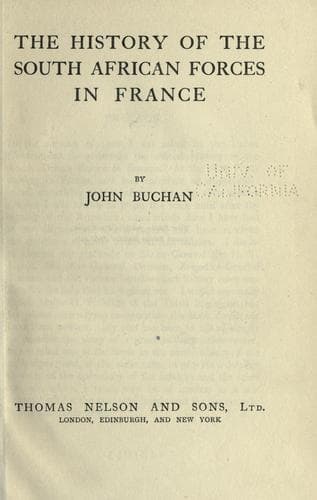
The history of the South African forces in FranceBuchan, John
History
The history of the South African forces in France
Buchan, John
South Africa. Army; World War, 1914-1918 -- Campaigns -- France; World War, 1914-1918 -- Regimental histories -- South Africa
On October 8, 1918, while flying home at a low altitude after destroying
an enemy two-seater near MARETZ, he was painfully wounded in the arm by
machine-gun fire; but, continuing, he landed safely at his aerodrome, and
after making his report was admitted to hospital.
In all, he has proved himself conqueror over fifty-four foes, destroying
twenty-two enemy machines, sixteen enemy kite balloons, and driving down
sixteen enemy aircraft completely out of control.
Captain Beauchamp-Proctor’s work in attacking enemy troops on the ground
and in reconnaissance during the withdrawal following on the battle of
ST. QUENTIN, from March 21, 1918, and during the victorious advance of
our armies commencing on 8th August, has been almost unsurpassed in its
brilliancy, and as such has made an impression on those serving in his
squadron and those around him that will not be easily forgotten.
Captain Beauchamp-Proctor was awarded the Military Cross on June 22,
1918; the Distinguished Flying Cross on July 2, 1918; a bar to the
Military Cross on September 16, 1918; and the Distinguished Service Order
on November 2, 1918.
CAPTAIN WILLIAM ANDERSON BLOOMFIELD, Scouts Corps, South African Mounted
Brigade.
At MLALI, East Africa, on August 24, 1916. For most conspicuous bravery.
Finding that, after being heavily attacked in an advanced and isolated
position, the enemy were working round his flanks, Captain Bloomfield
evacuated his wounded and subsequently withdrew his command to a new
position, he himself being among the last to retire. On arrival at the
new position he found that one of the wounded—No. 2475, Corporal D. M.
P. Bowker—had been left behind. Owing to very heavy fire he experienced
difficulties in having the wounded corporal brought in. Rescue meant
passing over some four hundred yards of open ground, swept by heavy fire,
in full view of the enemy. This task Captain Bloomfield determined to
face himself, and unmindful of personal danger, he succeeded in reaching
Corporal Bowker and carrying him back, subjected throughout the double
journey to heavy machine-gun and rifle fire. This act showed the highest
degree of valour and endurance.
No. 1630, SERGEANT FREDERICK CHARLES BOOTH, South African Forces,
attached Rhodesia Native Regiment.
At JOHANNESBRUCK, near SONGEA, EAST AFRICA, on February 12, 1917. For
most conspicuous bravery during an attack, in thick bush, on the enemy
position. Under very heavy rifle fire, Sergeant Booth went forward alone
and brought in a man who was dangerously wounded. Later, he rallied
native troops who were badly disorganized, and brought them to the firing
line. This N.C.O. has, on many previous occasions, displayed the greatest
bravery, coolness, and resource in action, and has set a splendid example
of pluck, endurance, and determination.
No. 4073, PRIVATE WILLIAM FREDERICK FAULDS, 1st Regiment, South African
Infantry.
Public-domain text, read in full here on John Shaqi.
Reviews
Reviews
No reviews yet
Be the first to share your thoughts on this work.
Elsewhere in the archive
Join the Discussion
Join the discussion
Sign in to leave a comment or review.
Sign InorCreate an account