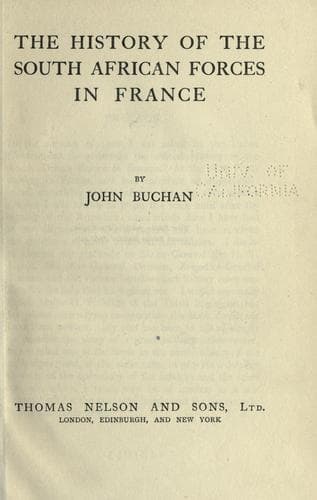
The history of the South African forces in FranceBuchan, John
History
The history of the South African forces in France
Buchan, John
South Africa. Army; World War, 1914-1918 -- Campaigns -- France; World War, 1914-1918 -- Regimental histories -- South Africa
The views of the military authorities in France did not, however,
coincide with those of Colonel Anderson. All the commandants of the bases
at which the companies were employed recommended that they should remain
where they were, and wrote highly of the men’s behaviour, bearing, and
discipline. It was a great disappointment to all that the companies
were not at once employed in the army areas; but a promise was given
that, if reinforcements proved sufficient, an experiment would be made
in employing them nearer to the actual scene of fighting. This was
eventually done, and the 1st, 3rd, and 5th Army Auxiliary Horse Companies
were taken over, the experiment proving an unmitigated success. The work
of these companies consisted in conveying ammunition and supplies to the
firing lines, and transporting metal for the new roads which had to be
constructed as the armies advanced.
Of the other companies which were employed on the lines of communication,
Numbers 2, 5, 8, and 22 Companies were employed at the docks, the bulk of
the work consisting in conveying munitions and supplies from the docks to
the different distributing centres. The work was hard, the hours long,
and the drivers much exposed to weather conditions.
Numbers 10 and 11 Companies were designated as “Forest Companies,” and
were employed almost entirely in hauling logs from the place where they
were felled to dumping centres. In a report on the work in the forests
in France, Lord Lovat, the Director of Forests, wrote that, without
prejudice to other units, he wished to remark on the work done by the
Horse Transport Companies manned by South African (Cape coloured)
_personnel_, who had shown throughout both practical knowledge of the
work and patriotic devotion to duty.
During their stay in France the health of the officers, N.C.O.’s, and men
was much better than could reasonably have been expected. Casualties were
estimated at 1 per cent. per month, but this figure was reduced by half.
APPENDIX VI.
VICTORIA CROSSES WON BY SOUTH AFRICANS DURING THE WAR.
LIEUTENANT (ACTING CAPTAIN) ANDREW WEATHERBY BEAUCHAMP-PROCTOR, D.S.O.,
M.C., D.F.C., No. 84 Squadron, Royal Air Force.
Between August 8, 1918, and October 8, 1918, this officer proved himself
victor in twenty-six decisive combats, destroying twelve enemy kite
balloons, ten enemy aircraft, and driving down four other enemy aircraft
completely out of control.
Between October 1, 1918, and October 5, 1918, he destroyed two enemy
scouts, burned three enemy kite balloons, and drove down one enemy scout
completely out of control.
On October 1, 1918, in a general engagement with about twenty-eight
machines, he crashed one Fokker biplane near FONTAINE and a second near
RAMICOURT; on 2nd October he burnt a hostile balloon near SELVIGNY; on
3rd October he drove down completely out of control an enemy scout near
MONT D’ORIGNY, and burned a hostile balloon; on 5th October, the third
hostile balloon near BOHAIN.
Public-domain text, read in full here on John Shaqi.
Reviews
Reviews
No reviews yet
Be the first to share your thoughts on this work.
Elsewhere in the archive
Join the Discussion
Join the discussion
Sign in to leave a comment or review.
Sign InorCreate an account