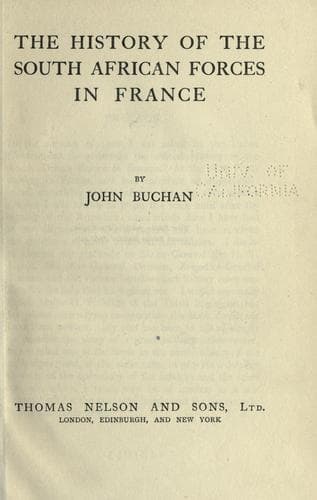
The history of the South African forces in FranceBuchan, John
History
The history of the South African forces in France
Buchan, John
South Africa. Army; World War, 1914-1918 -- Campaigns -- France; World War, 1914-1918 -- Regimental histories -- South Africa
That day’s battle cracked the kernel of the German defence in the
Salient. It showed only a limited advance, and the total of 3,000
prisoners had been often exceeded in a day’s fighting; but every inch
of the ground won was vital. Few struggles in the campaign were more
desperate or carried out in a more gruesome battlefield. The mass of
quagmires, splintered woods, ruined husks of “pill-boxes,” water-filled
shell-holes, and foul creeks which made up the land on both sides of the
Menin road was a sight which, to the recollection of most men, must seem
like a fevered nightmare. It was the classic soil on which, during the
First Battle of Ypres, the 1st and 2nd Divisions had stayed the German
rush for the Channel. Then it had been a battered but still recognizable
and featured countryside; now the elements seemed to have blended with
each other to make of it a limbo outside mortal experience and almost
beyond human imagining. Only on some of the tortured hills of Verdun
could a parallel be found. The battle of 20th September showed to what
heights of endurance the British soldier can attain. It was an example,
too, of how thought and patience may achieve success in spite of every
disadvantage of weather, terrain, and enemy strength.
[Illustration: SECOND-LIEUTENANT W. H. HEWITT, V.C., 2nd Regiment, South
African Infantry.]
Delville Wood was still for the Brigade the most heroic episode in the
War. But its advance on 20th September must without doubt be reckoned its
most successful achievement up to that date in the campaign. It carried
one of the strongest parts of the enemy’s position, and assisted the
brigades both on its right and left to take two forts which blocked their
way. The day was full of gallant individual exploits. The regimental
commanders led their men not only with skill, but with the utmost dash
and fearlessness. Heal was struck by shrapnel, and once buried by a
shell; Thackeray was twice buried; Cochran was knocked down, but rose
unhurt, though all thought him killed. “The regimental officers,” wrote
Dawson on the 22nd, “were an awful sight this morning, haggard and drawn,
unwashed and unshaven for four days, covered with mud and utterly tired,
but very happy, and exceedingly proud of their men.” One N.C.O. and
two men of the 2nd Regiment took seventy prisoners. Another man of the
2nd Regiment engaged a German in a bayonet duel and killed him; then a
second, whom he also killed; then a third, when each killed the other. In
dealing with the “pill-boxes,” individual courage and initiative were put
to the highest test. It was for such an episode that Lance-Corporal W. H.
Hewitt of the 2nd Regiment was awarded the Victoria Cross. He attacked
a “pill-box” in his section, and tried to rush the doorway, but found a
stubborn garrison within, and received a severe wound. Nevertheless he
managed to reach the loophole, where, in his attempts to insert a bomb,
he was again wounded. Ultimately he got a bomb inside, dislodged the
Public-domain text, read in full here on John Shaqi.
Reviews
Reviews
No reviews yet
Be the first to share your thoughts on this work.
Elsewhere in the archive
Join the Discussion
Join the discussion
Sign in to leave a comment or review.
Sign InorCreate an account