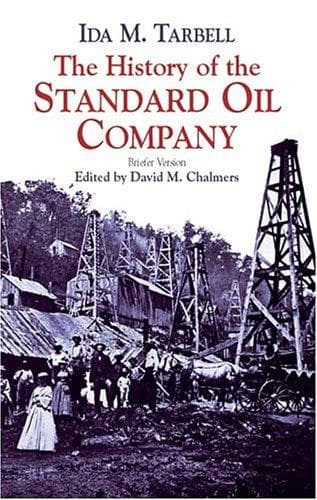
The History of the Standard Oil CompanyTarbell, Ida M. (Ida Minerva)
History
The History of the Standard Oil Company
Tarbell, Ida M. (Ida Minerva)
Petroleum industry and trade -- United States -- History; Standard Oil Company -- History
_Resolved_, that to give a wider market throughout the world to
petroleum, to enhance its price and to protect producers from unjust
combinations of home refiners, a committee be appointed to ask the
representatives of foreign governments at Washington to request
their respective governments to put a proper tariff on refined oil
and to admit crude oil free into the ports of their respective
governments.
Toward the end of October Captain Hasson presented the scheme which he
and the committee had prepared. It proposed that there should be
established what was called a Petroleum Producers’ Agency.[29] This
agency was really an incorporated company with a capital of one million
dollars, the stock of which was to be subscribed to only by the
producers or their friends. This agency was to purchase all the oil of
the members of the association at at least five dollars a barrel. If
stocks could be kept down so that the market took all of the oil at
once, the full price was to be paid at once in cash; if not, the agency
was to store the oil in tanks it was to build, and a portion of the
price was to be paid in tank certificates. By thus controlling all the
oil, the agency expected to protect the weakest as well as the strongest
producer, to equalise the interest of different localities, to prevent
refiners and exporters from accumulating stocks, and to prevent gambling
in oil. The agency was to take active means to collect reliable
information about the oil business—the number of wells drilling, the
actual production, the stocks on hand—things which had never been done
to anybody’s satisfaction. Indeed, one of the standing causes for
quarrels between the various newspapers of the region was their
conflicting statistics about production and stocks. It was to make a
study of the market and see what could be done to increase consumption.
It was to oppose monopolies and encourage competition, and, if
necessary, it was to provide co-operative refineries which the producers
should own and control.
The spirit of the agency, as explained by Captain Hasson, was most
liberal, considering the interests of even the drillers and pumpers.
“Advise every employee to take at least one share of stock for himself,”
he said in his address, “and one for his wife and each of his children,
and encourage him to pay for it out of his saved earnings or out of his
monthly pay. If he is not able to keep up his instalments, assure him
that you will help him, and then take care to do it. You will thus do
him a double kindness, and benefit his family by encouraging habits of
thrift and economy. You owe this much to him who so nobly seconded your
efforts to gain control of the market by stopping work. You had all to
gain, and he had nothing to hope for but your benefit. Now show your
appreciation of his acts by this evidence of your regard for his
welfare.”
Public-domain text, read in full here on John Shaqi.
Reviews
Reviews
No reviews yet
Be the first to share your thoughts on this work.
Elsewhere in the archive
Join the Discussion
Join the discussion
Sign in to leave a comment or review.
Sign InorCreate an account