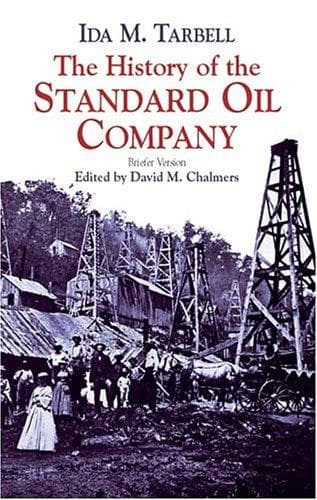
The History of the Standard Oil CompanyTarbell, Ida M. (Ida Minerva)
History
The History of the Standard Oil Company
Tarbell, Ida M. (Ida Minerva)
Petroleum industry and trade -- United States -- History; Standard Oil Company -- History
The plan was received with general enthusiasm, and when it came up for
adoption it went through with a veritable whoop. Indeed, within a few
moments after its official acceptance, which took place in Oil City on
October 24, $200,000 worth of stock was taken, and less than two weeks
later it was announced that more than the desired million dollars had
been subscribed, that the trustees and officers had been elected, and
that the agency was ready for work. For the first time in the history of
the oil business the producers were united in an organisation, which, if
carried out, would regulate the production of oil to something like the
demand for it, would prevent stocks from falling into the hands of
speculators, and would provide a strong front to any combination with
monopolistic tendencies. Only one thing was necessary now to make the
producer a fitting opponent to his natural enemy, the refiner. That
thing was loyalty to the agency he had established. The future of the
producer at that moment was in his own hand. Would he stick? By every
sign he would. He thought so himself. He had acted so resolutely and
intelligently up to this point that even Mr. Rockefeller seems to have
thought so.
During the entire three months that the producers had been organising,
the refiners had been making divers overtures to them. In August several
of the refiners sought certain of the big producers and privately
proposed a two-headed combination which should handle the whole
business, from drilling to exportation. The proposition they made was
most alluring to men suffering from low prices. “Carry out your plans to
limit your production and guarantee to sell only to us,” said Mr.
Rockefeller’s representative, “and we will give you four dollars a
barrel for your oil. We will also establish a sliding scale, and for
every cent a gallon that refined oil advances we will give you
twenty-five cents more on your barrel of crude.” The market price of
crude oil, when this offer was made, was hovering around three dollars.
“How,” asked the producer, “can you do this?” “We expect, by means of
our combination, to get a rebate of seventy-five cents a barrel,” was
the answer. “But the railroads have signed an agreement to give no
rebates,” objected the producers.
Public-domain text, read in full here on John Shaqi.
Reviews
Reviews
No reviews yet
Be the first to share your thoughts on this work.
Elsewhere in the archive
Join the Discussion
Join the discussion
Sign in to leave a comment or review.
Sign InorCreate an account