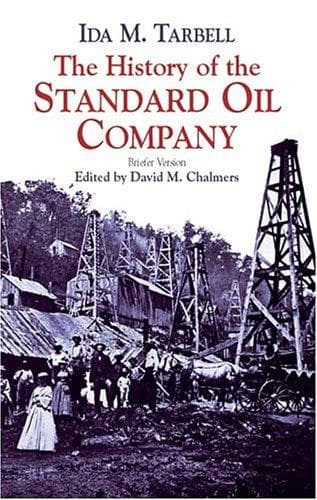
The History of the Standard Oil CompanyTarbell, Ida M. (Ida Minerva)
History
The History of the Standard Oil Company
Tarbell, Ida M. (Ida Minerva)
Petroleum industry and trade -- United States -- History; Standard Oil Company -- History
“As if the railroads ever kept an agreement,” answered the worldly-wise
refiners. “Somebody will get the rebates. It is the way the railroads do
business. If it is to be anybody, we propose it shall be our
combination.” Now it was clear enough to the men approached that the
great body of their association would never go into any scheme based on
rebates, and they said so. The refiners saw no disadvantage in that
fact. “We don’t want _all_ the producers. We only want the big ones. The
small producer under our arrangement must die, as the small refiner
must.” The proposition never got beyond the conference chamber. It was
too cynical. Several conferences of the same nature took place later
between representatives of the two interests, but nothing came of them.
The two associations were kept apart by the natural antagonism of their
ideals and their policy. Captain Hasson and his followers were working
on an organisation which aimed to protect the weakest as well as the
strongest; which welcomed everybody who cared to come into the business;
which encouraged competition and discountenanced any sort of special
privilege. Mr. Rockefeller and his associates proposed to save the
strong and eliminate the weak, to limit the membership to those who came
in now, to prevent competition by securing exclusive privileges. Their
program was cold-blooded, but it must be confessed that it showed a much
firmer grasp on the commercial practices of the day, and a much deeper
knowledge of human nature as it operates in business, than that of the
producers.
The formation of the Producers’ Agency brought the refiners back to the
Oil Regions in greater earnest than ever. The success of that
organisation gave them an active antagonist, one which, as it held the
raw material, could at any time actually shut up their refineries by
withholding oil. The vigour, the ability, the determination the new
organisation had displayed made it a serious threat to the domination
Mr. Rockefeller and his associates had dreamed. It must be placated. On
November 8, immediately after it was announced that the entire million
dollars’ worth of stock was taken, an agent of the Standard Oil Company
in Oil City was ordered to buy oil from the agency—6,000 barrels of oil
at $4.75 a barrel—and the order was followed by this telegram from Mr.
Rockefeller:
“It has been represented to us that if we would buy of the
producers’ agent at Oil City and pay $4.75 per barrel, they would
maintain the price. We are willing to go farther and buy only of the
producers’ agent, hence the order we have given you. See Hasson and
others and let there be a fair understanding on this point. We will
do all in our power to maintain prices, and continue to buy,
provided our position is fully understood. We do this to convince
producers of our sincerity, and to assist in establishing the
market.”
Public-domain text, read in full here on John Shaqi.
Reviews
Reviews
No reviews yet
Be the first to share your thoughts on this work.
Elsewhere in the archive
Join the Discussion
Join the discussion
Sign in to leave a comment or review.
Sign InorCreate an account