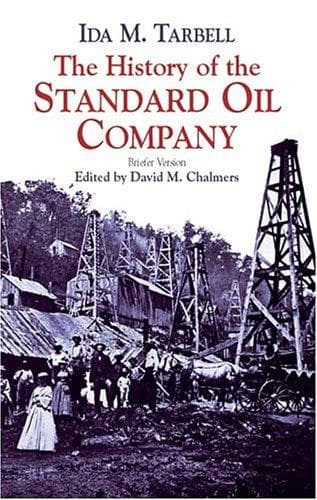
The History of the Standard Oil CompanyTarbell, Ida M. (Ida Minerva)
History
The History of the Standard Oil Company
Tarbell, Ida M. (Ida Minerva)
Petroleum industry and trade -- United States -- History; Standard Oil Company -- History
On December 12 the proposed treaty was laid before the producers at Oil
City. It aroused a debate so acrimonious that even the Derrick
suppressed it. Captain Hasson led the opposition. In his judgment there
was but one course for the producers—to keep themselves free from all
entanglements and give themselves time to build up solidly the structure
they had planned. If they had followed his advice the whole history of
the Oil Regions would have been different. But they did not follow it.
The treaty was ratified by a vote of twenty-seven to seven. The
excitement and the personalities the association indulged in at their
meeting augured ill for its future, but when a week later a committee
sent to see the refiners came back from New York with a contract signed
by Mr. Rockefeller,[31] the president, and bearing with them an order
for 200,000 barrels of oil at $3.25, there was a general feeling that,
after all, an alliance might not be so bad a thing. 200,000 barrels was
a big order and would do much to relieve their distress. Their formal
sense was quieted, too, by the assurance that the producers before
signing the contract had insisted that the Refiners’ Combination enter
into an agreement to take no rebates as long as the alliance lasted. The
main points of the agreement decided upon were that the Refiners’
Association should admit all _existing_ refiners to its society, and the
Producers’ Association _all_ producers present and to come—that the
former company should buy only of the latter, the latter sell only to
the former, and that the agency should bind all producers enjoying its
privileges to handle their oil through it. The refiners were to buy such
daily quantities as the markets of the world would take and at a price
governed by the price of refined, five dollars per barrel when refined
was selling at twenty-six cents a gallon. Either association could
discontinue the agreement on ten days’ notice. The producers, before
signing the contract, insisted that the Refiners’ Combination sign an
agreement to take no rebates as long as the alliance lasted. This
agreement in regard to rebates read as follows:
“_Whereas_, it is deemed desirable to execute a contract of even
date herewith between the Petroleum Producers’ Association and the
Petroleum Refiners’ Association for the purpose of securing a
co-operation for mutual protection, it is agreed by the Refiners’
Association that sections one and three of a contract made the 25th
of March, 1872, between certain trunk lines of railroads and a
committee of producers and refiners shall be and remain in full
force.
“Petroleum Refiners’ Association,
“JOHN D. ROCKEFELLER, _President_.”
Public-domain text, read in full here on John Shaqi.
Reviews
Reviews
No reviews yet
Be the first to share your thoughts on this work.
Elsewhere in the archive
Join the Discussion
Join the discussion
Sign in to leave a comment or review.
Sign InorCreate an account