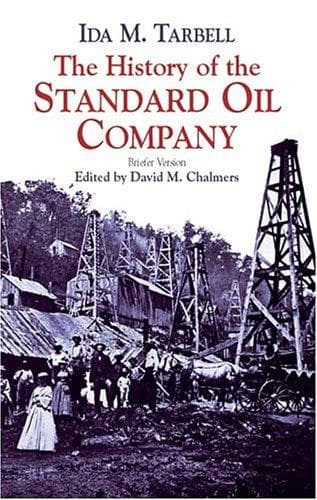
The History of the Standard Oil CompanyTarbell, Ida M. (Ida Minerva)
History
The History of the Standard Oil Company
Tarbell, Ida M. (Ida Minerva)
Petroleum industry and trade -- United States -- History; Standard Oil Company -- History
The sections of the contract of the 25th of March referred to agreed
that no rebates or contracts or other arrangements should be made which
would give any party the slightest difference in rates, and that the
rates should not be changed either for increase or decrease without
first giving Mr. Hasson, the president of the Producers’ Union, at least
ninety days’ notice in writing. As we now know, Mr. Rockefeller himself
was receiving rebates when he signed this agreement.
And now, at last, after five months of incessant work, the agency was
ready to begin disposing of oil. They set to work diligently at once to
apportion the 200,000 barrels the refiners had bought among the
different districts. It was a slow and irritating task, for a method of
apportionment and of gathering had to be devised, and, as was to be
expected, it aroused more or less dissatisfaction and many charges of
favouritism. The agency had the work well under way, however, and had
shipped about 50,000 barrels when, on January 14, it was suddenly
announced that the refiners had _refused to take any more of the
contract oil_!
There was a hurried call of the Producers’ Council and a demand for an
explanation. A plausible one was ready from Mr. Rockefeller. “You have
not kept your part of the contract—you have not limited the supply of
oil[32]—there is more being pumped to-day than ever before in the
history of the region. We can buy all we want at $2.50, and oil has sold
within the week at two dollars. If you will not, or cannot, stop
over-production, can you expect us to pay your price? We keep down the
output of refined, and so keep up the price. If you will not do the
same, you must not expect high prices.”
What could the producers reply? In spite of their heroic measures, they
had not been able to curtail their output. It seemed as if Nature,
outraged that her generosity should be so manipulated as to benefit only
the few, had opened her veins to flood the earth with oil, so that all
men might know that here was a light cheap enough for the poorest of
them. Her lavish outpouring now swept away all of the artificial
restraints the producers and refiners had been trying to build. The
Producers’ Association seemed suddenly to comprehend their folly in
supposing that when 5,000 barrels more of oil was produced each day than
the market demanded any combination could long keep the contract the
refiners had made with them; and their unhappy session, made more
unhappy by the reading of bitter and accusing letters from all over the
discontented region, ended in a complete stampede from the refiners, the
vote for dissolving the alliance having but one dissenting voice.
Public-domain text, read in full here on John Shaqi.
Reviews
Reviews
No reviews yet
Be the first to share your thoughts on this work.
Elsewhere in the archive
Join the Discussion
Join the discussion
Sign in to leave a comment or review.
Sign InorCreate an account