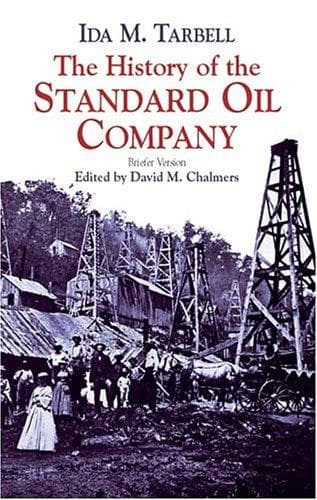
The History of the Standard Oil CompanyTarbell, Ida M. (Ida Minerva)
History
The History of the Standard Oil Company
Tarbell, Ida M. (Ida Minerva)
Petroleum industry and trade -- United States -- History; Standard Oil Company -- History
While these negotiations were going on, the Oil Regions as a whole was
troubled by a vague rumour that freight rates were to be advanced. In
the two years since the Oil War the region, as a whole, had adjusted
itself to the tariff schedule of March 25, 1872, and was doing very well
though working on a very much smaller margin of profits than ever
before. The margin was sufficient, however, to keep the refineries in
the valley running most of the time, and several of the large ones were
increasing their plants. Detailed accounts of the condition of the works
are to be had in the newspapers of the day. Thus, in the summer of 1874
an editor of the Oil City Derrick made a tour of the creek refineries
and reported all of the larger ones in Titusville and Oil City as
prosperous and growing, and the small ones in the little towns between
these two points as “jogging along pleasantly.” The keen competition
between the different refining points made it necessary to do business
with economy, and a rumour of a raise of freight rates naturally was
looked on with dread. It was not until September 12, however, that the
new arrangements were made known, and this was some time earlier than
was intended. The slip came about in this way. The general freight agent
of the New York Central road, James H. Rutter, sent out on September 9 a
private circular announcing the new arrangement,[41] an advance of fifty
cents a barrel on refined oil shipped to the seaboard, no corresponding
advance for Cleveland and Pittsburg, a rebate of the cost of getting oil
to the refineries and a rebate of twenty-two cents to those who
patronised certain pipe-lines. And to this new schedule was appended
this consoling paragraph: “You will observe that under this system the
rate is even and fair to all parties, preventing one locality taking
advantage of its neighbour by reason of some alleged or real facility it
may possess. Oil refiners and shippers have asked the roads from time to
time to make all rates even and they would be satisfied. This scheme
does it and we trust will work satisfactorily to all.”
Among the refiners to whom the circular went was M. N. Allen of
Titusville. Now Mr. Allen was the editor of an aggressive and lively
newspaper—the Courier. He had fought rings and deals from the beginning
of his career as a refiner and as an editor. He had been one of the
strong opponents of the South Improvement Company and of the Refiners’
Association which followed, and he saw at once the cloven foot in the
Rutter circular and hastened to denounce it in a strong editorial:
Public-domain text, read in full here on John Shaqi.
Reviews
Reviews
No reviews yet
Be the first to share your thoughts on this work.
Elsewhere in the archive
Join the Discussion
Join the discussion
Sign in to leave a comment or review.
Sign InorCreate an account