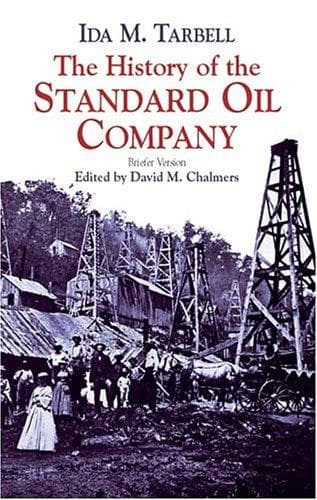
The History of the Standard Oil CompanyTarbell, Ida M. (Ida Minerva)
History
The History of the Standard Oil Company
Tarbell, Ida M. (Ida Minerva)
Petroleum industry and trade -- United States -- History; Standard Oil Company -- History
Mr. Harley laid the situation before the railroad men and said to them:
“We want you to help us keep up an even and equal pipage rate. Here we
are representatives of the nine most important lines in the Oil Regions.
We want to put a stop to cutting and keep up a rate of thirty cents.
Can’t you help us?” Now up to this time the railroad had had nothing to
do with pipe-line charges. It was, and still is, the custom for the
buyer of the oil to pay the pipage, that is, the oil producer on running
the oil into the pipe-line received a credit certificate for the oil. If
he held it in the line long he paid a storage charge. When he sold the
oil, the line ran it, and the buyer paid the charge for running. Now the
United Pipe Lines proposed to the railroads a through rate from the
wells to the seaboard as low as they currently made from the receiving
points on the railway, the pipes to get twenty per cent. of this through
rate. The railroads were to agree not to receive oil from buyers except
at as high a rate as the pipes charged; and to allow no pipe-line
outside of the alliance a through rate from the wells. The memorandum
said squarely that the intent and purpose of this was to make the United
Pipes the sole feeders of the railroads. It was a plan not unlike the
South Improvement Company in design—to put everybody but yourself out of
business, and it had the merit of stating its intent and purpose with
perfect candour.[40]
The railroad men seem not to have objected to the purpose, only to the
terms of the proposed arrangement. Mr. Blanchard told the pipe committee
that he regarded it as the most violent attempt on the part of the tail
to wag the dog that he had ever seen, and the representatives of the
other roads agreed. They saw at once, however, how much more solid their
own position would be if they could be sure that no pipe-line delivering
to them would cut its rate, if there could be in effect a through rate
from the wells, and after some discussion they proposed to the
pipe-lines to add twenty-two cents a barrel to the rail charges; that
is, if the rate to the seaboard was $1.25, to collect from the shipper
$1.47, and in case he could show that he had taken his oil from one of
the United Pipes to give him a rebate of twenty-two cents. Mr. Blanchard
said that they proposed to do this until proof was had that the
associated pipe-lines were acting in good faith. Of course this
arrangement did not change the pipe-lines’ methods of collecting in the
least. It simply forced a uniform charge, and this charge was to be, it
should be noticed, regardless of distance. The charge for collecting and
delivering oil was to be thirty cents a barrel whether it was carried
one or ten miles—a practice which prevails to-day.
Public-domain text, read in full here on John Shaqi.
Reviews
Reviews
No reviews yet
Be the first to share your thoughts on this work.
Elsewhere in the archive
Join the Discussion
Join the discussion
Sign in to leave a comment or review.
Sign InorCreate an account