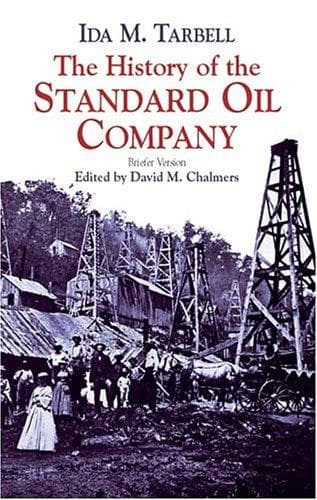
The History of the Standard Oil CompanyTarbell, Ida M. (Ida Minerva)
History
The History of the Standard Oil Company
Tarbell, Ida M. (Ida Minerva)
Petroleum industry and trade -- United States -- History; Standard Oil Company -- History
At first the Oil Region was puzzled by the Rutter circular. It certainly
was plausible. Was it not true that every man shared equally under it?
As the days passed, the dazed mental condition into which it had thrown
the oil men cleared up. Mr. Allen’s editorials began to take effect. The
pipe-lines left out of the pool began to ask how it could be legal that
the railroads should enter into an arrangement which obviously would
drive them out of business. The creek refiners began to ask by what
right the advantage of geographical position at the wells should be
taken from them, and Cleveland be allowed to retain the advantages of
her proximity to the Western market; Pittsburg her position on the Ohio
River and the market it commanded; all of the cities the advantage of
their proximity to great local markets and to such necessary supplies as
barrels and acids. Besides, was it constitutional for the railroads thus
to regulate interstate commerce? Was not the arrangement, as far as the
Pennsylvania was concerned, plainly prohibited by the new constitution
of the state of Pennsylvania? The producers slowly began to realise,
too, that the Rutter circular, like the South Improvement charter and
contracts, did not recognise them as a body. The contract of March 25,
1872, provided that the rates fixed should not be “liable to any change
either for increase or decrease without first giving to William Hasson,
president of the Producers’ Union, at Oil City, at least ninety days’
notice in writing of such contemplated change.” This agreement was
totally ignored. It was an “insolent equalisation,” the oil men
concluded, and the sum total of their dissatisfaction finally found
expression at a mass-meeting at Parker’s Landing, on October 2. Directly
after this meeting a committee appointed sent to Messrs. Scott,
Vanderbilt and Jewett, the new president of the Erie, letters calling
their attention to the Rutter circular, and stating the objections of
the producers to it. These letters sent on October 6 received no
attention from any of the railroad presidents addressed for over three
weeks, when the following was received from the Pennsylvania:
_Gentlemen_:—Your communication of the 6th inst., to Thomas A.
Scott, president, was received, and has been referred to me.
In establishing the recent rates and arrangements for the
transportation of oil, the object which was at all times kept in
view was to place all interests on an equality, giving to no one an
undue advantage over any other.
We believe that this object has been accomplished, and that by
adhering to our present rates the interests both of the producers,
refiners and transporters will be promoted.
Very truly yours,
A. J. CASSATT.
Public-domain text, read in full here on John Shaqi.
Reviews
Reviews
No reviews yet
Be the first to share your thoughts on this work.
Elsewhere in the archive
Join the Discussion
Join the discussion
Sign in to leave a comment or review.
Sign InorCreate an account