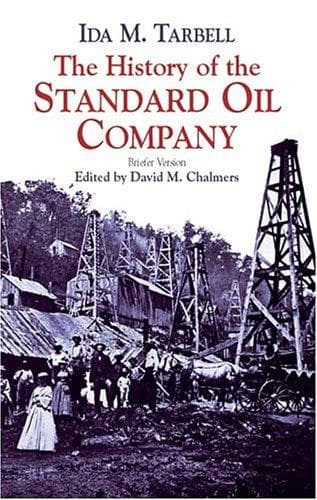
The History of the Standard Oil CompanyTarbell, Ida M. (Ida Minerva)
History
The History of the Standard Oil Company
Tarbell, Ida M. (Ida Minerva)
Petroleum industry and trade -- United States -- History; Standard Oil Company -- History
“Brief, tardy and unsatisfactory,” was the Derrick’s characterisation of
Mr. Cassatt’s letter. It was evidence to the oil men that if anything
was to be done to break the new tariff it would have to be done in
court, for the railroads meant to stand by their creation.
In this discussion of the Rutter circular Mr. Rockefeller’s name
scarcely appeared. It was known that he had been admitted to the
conferences at which the tariff was arranged. This was taken as a matter
of course. There was nothing which concerned the oil business which John
Rockefeller was not on the inside of. Mr. Blanchard later stated that
the “crude equivalent” scheme was suggested by certain Western refiners.
The tremendous advantage Cleveland secured by the new arrangement,
practically 300 miles of free transportation, seemed to prove, too, that
Mr. Rockefeller had not been inactive during the conference. Whether he
had or had not suggested the points in the “Rutter circular” so
advantageous to his interests, he used them now to aid him in
accomplishing one of the shrewdest and most far-reaching moves of his
life—the move which was to lead at last to the realisation of his Great
Purpose—the concentration of the oil business in his own hands. For Mr.
Rockefeller, quiet as he had been since the breaking up of the Refiners’
Association in the summer of 1873, had by no means given up the idea of
doing for the refining interest of the whole country what he had done
for that of Cleveland through the South Improvement Company.
Mr. Rockefeller has shown repeatedly in his conquering business career
remarkable ability to learn from experience. The breaking up of the
Refiners’ Association _may_ have seemed a disaster to him. He did not
allow it to be a profitless disaster. He extracted useful lessons from
the experience, and, armed with this new wisdom, bent his whole mind to
working out a third plan of campaign. He now knew that he could not hope
to make again so rich a haul as he had made through the defunct South
Improvement scheme. The experience of the past year with the refiners
convinced him that it would take time to educate them to his idea of
combination; but he had learned who of them were capable of this
education. As for the producers, the alliance attempted with them was
enough to demonstrate that they would never endure long the restraints
of any association. Besides, the bulk of them still held the, to him,
unpractical belief that rebates were _wrong_. Mr. Rockefeller had also
re-learned in these eighteen months what he knew pretty well before,
that the promise to give or take away a heavy freight traffic was enough
to persuade any railroad king of the day to break the most solemn
compact.
Public-domain text, read in full here on John Shaqi.
Reviews
Reviews
No reviews yet
Be the first to share your thoughts on this work.
Elsewhere in the archive
Join the Discussion
Join the discussion
Sign in to leave a comment or review.
Sign InorCreate an account