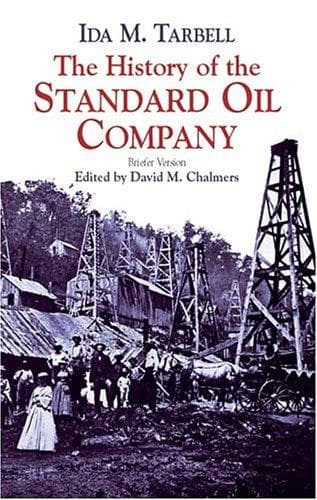
The History of the Standard Oil CompanyTarbell, Ida M. (Ida Minerva)
History
The History of the Standard Oil Company
Tarbell, Ida M. (Ida Minerva)
Petroleum industry and trade -- United States -- History; Standard Oil Company -- History
No one of the roads knew certainly what the others were doing for the
Standard until October 1, 1875. The freight agents then met to discuss
again the freight pool they had formed in 1874. It had not been working
with perfect satisfaction. The clause granting the rebate of twenty-two
cents to the pipe-lines which sustained an agreed rate of pipage had
been abandoned after about five months’ experiment. It was thought to
stimulate new pipes. The roads in making a new adjustment made no effort
to regulate pipe-line tariffs. The “crude rebate” as it was
called—carrying oil to a refinery for nothing—was left in force. At this
meeting Mr. Blanchard found that both of the Erie’s big rivals were
granting the Standard a ten per cent. rebate. He also found that he was
not getting fifty per cent. of the Standard’s business as the contract
called for—that the Standard controlled not only the Cleveland and New
York works of which he knew, but large works in Pittsburg and
Philadelphia.[48]
Mr. Rockefeller was certainly now in an excellent condition to work out
his plan of bringing under his own control all the refineries of the
country. The Standard Oil Company owned in each of the great refining
centres, New York, Pittsburg and Philadelphia, a large and aggressive
plant run by the men who had built it up. These works were, so far as
the public knew, still independent and their only relation that of the
“Central Association.” As a matter of fact they were the “Central
Association.” Not only had Mr. Rockefeller brought these powerful
interests into his concern; he had secured for them a rebate of ten per
cent. on a rate which should always be as low as any one of the roads
gave any of his competitors. He had done away with middlemen, that is,
he was “paying nobody a profit.” He had undeniably a force wonderfully
constructed for what he wanted to do and one made practically
impregnable as things were in the oil business then, by virtue of its
special transportation rate.
As soon as his new line was complete the work of acquiring all outside
refineries began at each of the oil centres. Unquestionably the
acquisitions were made through persuasion when this was possible. If the
party approached refused to lease or sell, he was told firmly what Mr.
Rockefeller had told the Cleveland refiners when he went to them in 1872
with the South Improvement contracts, that there was no hope for him;
that a combination was in progress which was bound to work; and that
those who stayed out would inevitably go to the wall. Naturally the
first fruits to fall into the hands of the new alliance were those
refineries which were embarrassed or discouraged by the conditions which
Mr. Rogers explains above. Take as an example the case of the Citizens’
Oil Refining Company of Pittsburg, as it was explained in 1888 to the
House Committee on Manufactures in its trust investigation. A. H. Tack,
a partner in the company, told the story:[49]
Public-domain text, read in full here on John Shaqi.
Reviews
Reviews
No reviews yet
Be the first to share your thoughts on this work.
Elsewhere in the archive
Join the Discussion
Join the discussion
Sign in to leave a comment or review.
Sign InorCreate an account